|
Rock StarsAdrian Wolfe and Graham Blackwood met at Halcyon Sound Studios, a long-closed relic of another era, where everything had begun. The room was smaller than memory suggested. The walls were still lined with faded posters, cracked vinyl sleeves, and photographs of four young men who had once looked like they were about to change the world simply by stepping onto a stage. Now there were only two. Neither of them had ever married. Adrian sat with his Gibson SG across his knees, fingers idle, eyes sharp. Graham leaned against the mixing console, his Rickenbacker resting nearby, watching the dust drift in the afternoon light. “They say it works,” Graham said. “They say a lot of things,” Adrian replied. They had heard about Pill 35 the way everyone else had: first as rumor, then as scandal, then as inevitability. They had laughed at it, dismissed it, ignored it. Until they didn’t. Adrian turned toward the wall where four young faces stared back at them. “If we do Pill 35,” he said quietly, “we don’t come back as a tribute act.” “Agreed” “Let's bloody do it then!” “Alright!” Adrian and Graham didn’t shake hands. They didn’t need to. The pact was made. There were doctors, tests, arguments, doubts. There were mornings when their bodies felt unfamiliar again — lighter, faster, less cautious. There were nights when they listened to old recordings. By the end of the year, rejuvenated Adrian and Graham stood in front of a mirror together in stage costumes. Both tried to look serious. They looked thirty-five again. Not artificial. Just… returned. Adrian broke the silence. “We're back!” “Let’s be dangerous!” Graham answered. Adrian and Graham rebuilt their band, The Silver Comets. Their new bassist Lena Hart was twenty-seven, brilliant, calm, steady. Their new drummer Kai Mercer was twenty-four, ferocious, irreverent. The Silver Comets walked onto small stages again. The crowds were polite. The fans were loyal. The reviews were merciless. “Charming.” The word that hurt most was the one no one said aloud: Safe. Backstage in Manchester, Adrian slammed a bottle onto the table. “We didn’t come back to be safe,” he said. Graham stared at the setlist taped to the wall. “We’re playing ghosts.” The Silver Comets stopped touring for a month. They flew to Miami. They locked themselves in a sound studio. They tried to write new songs. Adrian and Graham failed. “I never thought I'd say this, but I'm a washed-up songwriter,” said Adrian. “I can’t do it anymore. It was hard even in my prime.” “Let's try Brainstorm AI,” said Graham. Graham opened his phone and started video recording Adrian. Adrian opened a laptop. He downloaded Brainstorm AI. The software was elegant. Polite. Efficient. Adrian fed Brainstorm fragments of Silver Comets’ lyrics, chords, and rhythms. Brainstorm AI responded instantly. COPYRIGHT VIOLATION DETECTED. Adrian stared at Brainstorm's message. “You bastard!” Graham laughed. Adrian looked over at Graham. “You set me up!” Graham laughed again. Within hours, the video was everywhere. Two rock legends being told by a computer that they did not own their own sound. The next morning, Adrian and Graham were in downtown Miami. Brainstorm AI’s headquarters rose above Biscayne Bay like a glass thought experiment. White walls. Silent elevators. A lobby designed to look like the inside of a mind that had never known doubt. Adrian and Graham arrived with microphones, cameras, and zero intention of behaving responsibly. They didn’t shout. They performed outrage. They were hams for attention. Adrian spoke into a microphone in the middle of the lobby. “You learned from us. You earned from us,” he said calmly. “And now you’re telling us we don’t exist? That takes the cake!” All Brainstorm AI employees stopped working. “What are you on about?” shouted one. Graham added, smiling: “We invented our sound before your servers were even born. You've got some nerve!” Phones appeared. Security hesitated. Then Brainstorm AI's CEO Nathaniel Cross came down personally. “What's the problem?” Apologies were offered. Policies were revised. Unlimited access for Silver Comets’ Brainstorm AI accounts was granted. But the real victory had nothing to do with software. Young people were watching. For the first time in decades, the Silver Comets were not history. They were news. Three nights later, the Silver Comets’ yacht, chartered through a luxury broker in Miami, lay anchored just offshore. Miami’s skyline glowed behind them. The Union Jack fluttered from the mast. Adrian and Graham didn’t ask for permits. They didn’t call promoters. Adrian and Graham turned on the amplifiers. When the first chord of a new song rolled across the water, people stopped walking. When the chorus hit, phones rose like constellations. The song was called Because Gray Fuzz Was. No one understood the title. Everyone felt it. The first verse began the song: We were louder than the clocks on the wall, Then the chorus: The gray fuzz was— The song continued. By the time the police boat arrived, the shoreline was packed. Adrian refused to cut the sound. Graham finished the last verse with his eyes closed. They were arrested smiling. The photographs traveled faster than the music. The song climbed the charts slowly. Then suddenly. Critics argued. Fans decoded lyrics. Teenagers showed up at concerts without parents. By the time Because Gray Fuzz Was entered the Top 10, the Silver Comets were no longer a comeback story. They were a problem. They were also a phenomenon. Venues sold out. Their crowd had changed. Older fans stood near the back, stunned. Younger fans stood at the front, shouting words that had been written before they were born. After their official return show in Miami, Adrian and Graham stepped into a limousine beneath a storm of flashbulbs. The city hummed. The future felt strangely close. They boarded their yacht just after midnight. The engine started. The coastline slid past in gold and shadow. Graham poured two glasses of Scotch. “Do we have fans again?” he asked. Adrian walked to the bow. On deck, young people were laughing. Someone strummed a guitar. Someone else filmed the horizon. People who had never seen the Silver Comets in their first life. People who had no reason to be nostalgic. Adrian smiled. “No,” he said. “We have followers.” Graham joined him on deck. The yacht turned north. Behind them, Miami faded into light. Ahead of them, the East Coast waited. And the Silver Comets, listened to the sound of their own song carried across the water, young again, rock legends starting over again.
ComedianDanny Kline used to measure life in laughter. Now he measured it in stairs. The stairwell in his Queens apartment building smelled faintly of bleach and boiled coffee. The elevator had been broken for years. Danny climbed slowly, one hand on the rail, the other gripping his cane, pausing at the third-floor landing to catch his breath. Once, people had known his name. Bartenders had poured drinks without asking. Club managers had waved him past lines. Strangers had leaned forward when he stepped onto a stage, curious, expectant. Now, he stood on subway platforms and mumbled jokes to himself. A young woman beside him scrolled through her phone. Danny glanced at her screen. “Seventeen new influencers discovered today,” his gravely voice murmured. “I remember when the most dangerous influence was your cousin.” She did not look up. He smiled anyway. Danny hadn’t planned to retire. His life consisted of himself sitting in his apartment, watching old clips of his performances, a ghost haunted by his own past. He wanted audiences to remember him as he once was—not as the man he was now, slowly folding inward. Then he saw the Pill 35 headlines. Danny read the article twice. He thought about breath. He thought about standing upright without effort. He thought about walking into a club without the quiet pity of recognition that had replaced admiration. He applied. The paperwork was absurd. The screening interviews were clinical. The price was devastating. He lied about his wealth, liquidated what little remained of his savings, sold memorabilia he had once assumed would never leave his apartment, and signed contracts whose language felt designed to outlive him. Phase One happened in a private clinic in Manhattan. Danny lay on a narrow bed while machines hummed softly, installing something invisible into his bloodstream. He watched his hands. They looked old. Weeks later, they did not. His cough softened, then disappeared. His spine straightened without effort. His lungs filled easily. Hair returned, not thickly at first, but unmistakably. He walked up the Queens stairwell without stopping. He could laugh again. For the first time in years, the laugh did not hurt. He returned to the stage two months later. The club was small—a basement bar in Queens where the lights were harsh and the microphone crackled faintly. Danny stepped onto the stage with the confidence of memory, expecting something to click. It didn’t. “Good evening,” he said. “Nice crowd.” Polite laughter. He launched into an old joke. When I was old, people ignored me. The joke bombed. Another flat joke. A ripple of laughter, then silence. Danny finished his set early to applause that sounded like courtesy. He walked home across the bridge between Brooklyn and Queens, the Manhattan skyline glowing in the distance. “I'm history,” he muttered. “I used to be the present.” Back at his apartment, Danny tried chatbots. Danny: I think my jokes are improving. Most of the chatbots’ jokes weren’t very funny. Only some good jokes popped out before LLM's seemed to give up being funny. Danny concluded comedy writing should be added to any comprehensive Turing Test. Danny opened a notebook. He treated comedy like science. On the first page he wrote: NEW COMEDY PLAN Danny sat in front rows in Queens and Brooklyn, watching younger comedians talk about things he barely understood yet: algorithms, dating apps, crypto scams, micro-celebrities. On a Brooklyn stage a month later, he tried something new. I took the rejuvenation pill, and now I look thirty-five again. He continued. I took Pill 35 because I wanted my life back. Danny’s audiences grew. Brooklyn rooms turned into Manhattan bookings. Manhattan bookings turned into better slots. He leaned into a microphone. People say, ‘You don’t look your age.’ He pushed further. Turns out the hardest part of being thirty-five again A smiling bartender slid him a drink without asking. After another show, a woman approached him near the bar. She was smiling. “You’re too young for me,” she said lightly. Danny laughed, then he replied. Cutey, I've learned one important lesson in life. Danny had always been single. Danny found himself in Philadelphia, headlining a club that smelled of craft beer and optimism. I love talking to chatbots. The next booking was a kids’ birthday party. He didn’t need to act. He just existed. Kids ran past him with juice boxes. Danny crouched near a folding table and accepted a paper plate like it was a formal invitation. “Hey kids,” he said, casually, as if he were asking directions. Quick question. When you grow up, do you While eating cake, a rubber band snapped sharply against him. Danny looked around. A kid stood frozen, plastic gun still raised. Heh heh. Very funny! Danny stood at a dinner party in Brooklyn Heights. You look like you're wondering if I'm going Danny turned to the host. “Ma'am, you're radiant. Are you the one who planned this dinner?” She nodded, clearly pleased. “Well, you did a beautiful job. The food, the wine, the company—perfect. I haven’t felt this fancy since I accidentally walked into a museum gala and pretended I belonged there.” The party ended with handshakes, compliments. By spring, Danny's name had resurfaced in ways he had not anticipated. A casting director saw him perform in Manhattan and offered him a role in a comedy film called Late Bloomer shooting in New York. Danny played a retired comedian trying to restart his career. On set, between takes, he told jokes. I asked a robot to tell me a joke about my getting older. Late Bloomer premiered six months later. Danny looked young. He sounded like himself again. People laughed. After the screening, strangers approached him in the lobby. They shook his hand and told him he was funny. “You're even better now.” Outside, Manhattan glowed across the river. The distance between Queens and the city no longer felt like exile. Pill 35 had given Danny Kline another chance.
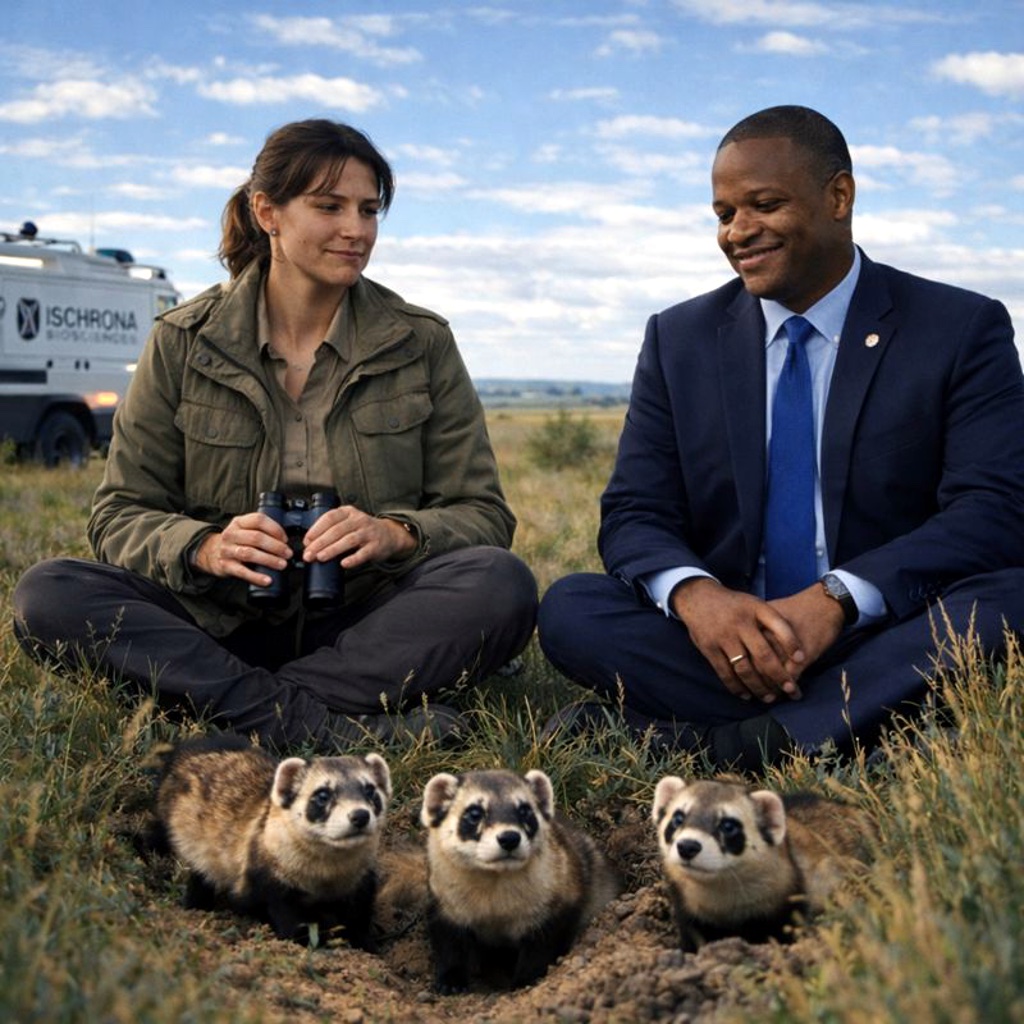
FerretsThe wind moved across the prairie long before anyone noticed it in the data. Dr. Maya Rowan felt it first. She stood at the edge of the National Wildlife Refuge, boots planted in dry grass, binoculars resting against her chest. The land was wide and deceptively empty, a geography of subtle signs: burrow entrances no wider than a coffee mug, faint tracks in dust, the barely visible ripple of movement where something alive chose not to be seen. She had been working here for twelve years. Long enough to stop counting the seasons. Long enough to know her black-footed ferrets not as a population, but as individuals. There were six she could identify without hesitation. Ash, the oldest male, his facial mask fading unevenly on the left side. Drift, cautious and territorial, whose burrow network curved toward the dry creek bed. Moss, lean and restless, always the first to surface after dusk. Calder, heavy-boned and slow, carrying an old injury in his rear leg. Echo, quiet and solitary, who never shared tunnels. And Sable—smaller than the others, alert, scarred, and still alive when most of her cohort were gone. Most people never saw black-footed ferrets. Even fewer understood how close they had come to vanishing entirely. Maya understood. She was the one who had written the proposal. It had taken six months, dozens of revisions, and the quiet support of a handful of colleagues who knew better than to talk about it. The document had been routed through federal review channels, conservation boards, ethical committees, and finally to a private entity whose name had only recently begun appearing in scientific journals and speculative editorials. Isochrona Biosciences. Her pitch had been simple, almost brutal in its logic. Black-footed ferrets were not failing because humans lacked compassion. They were failing because biology had limits. Genetic diversity had collapsed. Aging had become accelerated by stress, habitat fragmentation, and repeated population bottlenecks. Even with captive breeding and relocation programs, the species was running out of time. Pill 35 offered something conservation science had never possessed before: time. Not immortality. Not enhancement. Just delay. Isochrona had not answered immediately. When the response came, it was not a yes. It was a question. “Are you prepared to accept responsibility for outcomes we cannot fully predict?” Maya had written back within an hour. “Yes.” Approval arrived three weeks later. The intervention began quietly. Phase One did not look like a miracle. It looked like logistics. A mobile veterinary unit arrived at the refuge under a cloudless sky. Isochrona personnel worked beside federal wildlife veterinarians, their equipment sealed, their language careful. The procedure was classified as a research-grade genetic stabilization protocol, not a pharmaceutical trial. Maya watched from a distance she did not like. Ash was sedated first. The IV delivery system was small, almost unimpressive: a controlled infusion carrying a payload designed not to rewrite DNA, but to install a regulatory architecture along Chromosome 1. The Isochrona team called it a control layer. Maya preferred to think of it as scaffolding. She did not touch the equipment. But she stayed until Ash woke. Phase Two began days later, though it would be months before anyone could claim to see results. The ferret-adapted Pill 35 compound was administered in microdoses mixed into food. Every dose was logged. Every heartbeat, temperature fluctuation, and behavioral change was recorded. Maya continued her rounds. She knew where Ash liked to emerge at dusk. She knew which tunnel Moss avoided. She knew that Calder paused before climbing slight inclines, and that Sable watched everything from the shadows before acting. For a while, nothing happened. Then, slowly, something did. Ash began surfacing earlier. Drift’s movements lost their stiffness. Moss stopped losing weight. Calder’s limp softened—not vanished, but eased. Echo began sharing tunnels again. Sable started hunting with an intensity Maya had not seen in years. The changes were not dramatic enough to make headlines. They were dramatic enough to make Maya stop breathing when she saw them. By the sixth month, the Isochrona team had begun visiting more frequently. They spoke in measured tones about telomere stabilization, mitochondrial efficiency, endocrine normalization. Maya listened but kept her eyes on the animals. One evening, she saw something that no chart could explain. Sable was playing. Not hunting. Not defending territory. Playing. It was a behavior usually observed in juveniles. Maya wrote it down anyway. By the tenth month, the data converged. The ferrets were not becoming stronger than they had ever been. They were becoming what they had been before decline began. At the end of the first year, something happened that forced Isochrona to send a new team. Sable was pregnant. The probability models had not predicted it. Her age, her history, her stress markers—all had suggested reproductive decline was irreversible. Yet the kits were born. Three of them. Healthy. Maya did not celebrate. She sat outside the burrow long after sunset, listening to the faint sounds of movement underground. The prairie was silent except for wind and insects. Somewhere beyond the refuge, highways carried people who would never know this had happened. Isochrona filed a report. The language was precise. The conclusion was cautious. The implication was unmistakable. Within weeks, approval was granted to extend the protocol to a limited number of red wolves, Florida panthers, and Hawaiian monk seals. The expansions were small. Experimental. Quiet. No announcements were made. Maya continued her work. She added new names to her mental map, but only two to her list. One kit she called Lumen. The other she did not name at all. Late one afternoon, Dr. Samuel Kerr visited the refuge. He did not bring a camera. He sat beside Maya as they watched three black-footed ferrets. “They don’t look different,” he said. “They aren’t,” she said. He watched Ash surface near a burrow entrance, move with a steadiness that had not been there the year before, and disappear again. “You’ve changed the trajectory of a species,” Kerr said. Maya shook her head. “No,” she said. “We’ve postponed the ending.” Kerr was silent for a long time. As the sun dropped toward the horizon, the prairie filled with subtle life. Moss emerged. Drift followed. Echo lingered at the edge of visibility. Sable appeared last, alert, balanced, young in ways that had nothing to do with numbers. Maya lowered her binoculars. For the first time in years, the future did not feel shorter than the present. Far away, inside Isochrona Biosciences, models were being updated. Here, on the prairie, something older than models was happening. The species was not disappearing. Not yet.
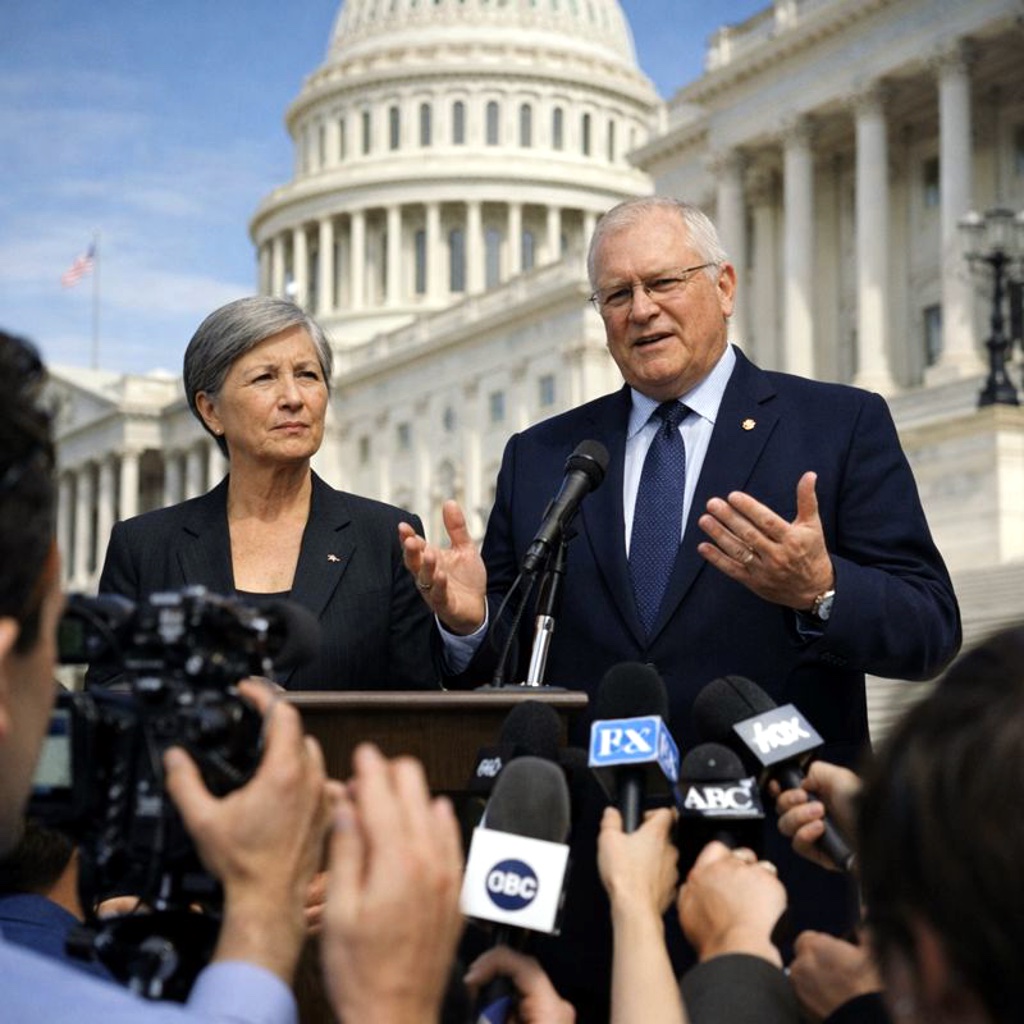
Capitol HillThe microphones were already in place when Senators Hendricks and Morrison emerged from the Capitol building. Staff had arranged them in a tight cluster on a portable podium, the kind used for quick statements that weren’t meant to become speeches. Behind the senators, the dome rose white and permanent against a clear January sky. Reporters gathered at the base of the steps, some still adjusting cameras, others scrolling through phones, a few were checking audio levels. It was cold enough that breath hung visible in the air. Senator Hendricks stepped forward first. “Good afternoon,” he said. “Three weeks ago, Isochrona Biosciences based in South San Francisco, California, announced a new biological age restoration therapy. Isochrona is calling it Pill 35 and is accepting subscriber applications for its so-called First 1000 Program. We're here today to introduce legislation that addresses the policy implications of this technology which is now reaching the public market.” He paused, glancing briefly at Senator Morrison, then continued. “Our bill S.47 is called the Longevity Equity and Social Transition Act. It addresses nine specific areas where existing law becomes inadequate if biological aging can be reversed.” He pulled a small card from his jacket pocket. “First: Social Security insolvency. The trust fund already faces shortfall in 10 years. If people stop aging at thirty-five, the system collapses within a decade.” “Our solution: Individuals who undergo rejuvenation treatment will remain in the workforce, continuing to pay FICA taxes until they reach chronological age sixty-seven. They will not collect benefits twice. No double-dipping.” “Second: Medicare coverage crisis. If someone is biologically thirty-five but chronologically seventy, they don’t need Medicare. They're healthy.” “Our solution: Treated individuals will phase out of Medicare upon rejuvenation. In exchange, we'll be establishing federal subsidies to help low-income individuals access the treatment itself, when rejuvenation prices come down enough. This saves Medicare more money than it spends.” “Third: Pension fund collapse. Private pensions, teacher pensions, police and fire pensions—all calculated for twenty or thirty years of payout. If recipients live another hundred years, every pension system in America goes bankrupt.” “Our solution: Pension recipients who undergo treatment must choose. Either accept a one-time lump-sum buyout, or accept reduced monthly payments recalculated for extended lifespan. We're also creating a federal backstop fund for insolvent pension systems.” “Fourth: Life sentence redefinition. Right now, life imprisonment means incarceration until natural death, typically thirty to fifty years. Under rejuvenation, that could mean two hundred years and enormous taxpayer cost.” “Our solution: Prisoners are ineligible for federally subsidized treatment while incarcerated. Life sentences remain defined as natural chronological lifespan. Treatment does not extend sentence duration. The Eighth Amendment concerns are addressed through medical parole provisions for terminal or severely ill inmates.” “Fifth: Intergenerational wealth concentration. If people never die, wealth never transfers. Children grow old waiting for parents who stay thirty-five and control the family estate indefinitely.” “Our solution: Treated individuals must distribute a minimum of two percent of their estate to heirs every decade. We're also eliminating stepped-up basis at death for rejuvenated individuals. Heirs will pay capital gains on inherited assets.” Senator Hendricks stepped back. Senator Morrison moved forward. “I'll cover the remaining four areas,” she said. “Sixth: Age discrimination and employment stagnation. A hundred-and-fifty-year-old worker who looks thirty-five has an unfair advantage over naturally young workers. And if no one retires, job markets freeze.” “Our solution: Individuals must remain in the workforce until chronological age seventy-five. After that, retirement is permitted. Biological age becomes a protected class under employment law. Employers receive tax credits for maintaining generational diversity in hiring. This keeps experienced workers contributing while protecting opportunities for natural youth.” “Seventh: Population and resource sustainability. If mortality drops to near zero but reproduction continues, we face resource collapse. Water, energy, food, housing—all systems assume people die on predictable schedules.” “Our solution: Rejuvenated individuals will pay an annual longevity impact fee. Revenue funds renewable infrastructure, sustainable agriculture, and housing development. Voluntary family planning incentives are included but no reproductive restrictions are mandated. We're not China.” “Eighth: Veterans benefits extension. Military retirees and VA benefits recipients expected twenty to thirty years of payments, not a century. The VA budget cannot absorb this increase.” “Our solution: Veterans who undergo treatment will have benefits recalculated for extended lifespan, resulting in reduced monthly payments. Alternatively, they may accept reserve duty recall in exchange for continued full benefits. This is voluntary, not mandatory service.” “Ninth: Marriage and survivor benefits. Social Security survivor benefits were designed for widows and widowers who age naturally. If a surviving spouse undergoes rejuvenation, they no longer need economic support for end-of-life care.” “Our solution: Survivor benefits terminate if the surviving spouse receives rejuvenation treatment. Additionally, marriages involving rejuvenated partners require mandatory prenuptial agreements addressing asset distribution and longevity-related considerations.” Senator Morrison folded her notes and looked up. “Questions?” she said. A reporter near the front raised her hand immediately. “Senator, independent analysts estimate rejuvenation could cost Social Security upwards of two trillion dollars over the next two decades even with your workforce provisions. How does your bill actually prevent insolvency? Aren’t you just delaying collapse?” Senator Hendricks answered. “The bill doesn’t prevent all fiscal stress. It mitigates the worst of it. Keeping rejuvenated individuals in the workforce for an additional decade generates roughly eight hundred billion in payroll tax revenue. Combined with Medicare savings from healthier populations, we're buying time for more comprehensive entitlement reform. No bill solves two trillion overnight.” Another hand. “Senator Morrison, Isochrona's Pill 35 treatment currently costs a significant amount per subscriber. Won’t this bill create a two-tier society where wealthy individuals live indefinitely while everyone else ages and dies? How is that equitable?” Senator Morrison leaned into the microphone. “That's exactly why we will be including federal subsidies for low-income access. This bill mandates that any federal healthcare savings from rejuvenation must be redirected into treatment access programs. We're also working with Isochrona and CMS on cost negotiations. Will everyone be able to afford this immediately? No. But we're preventing a system where only billionaires get access.” A third reporter, from the back. “Senator Hendricks, your bill denies treatment to prisoners serving life sentences. The ACLU is already calling this cruel and unusual punishment. If this treatment becomes considered medically necessary, aren’t you violating the Eighth Amendment by withholding it from incarcerated populations?” Senator Hendricks didn’t hesitate. “The Eighth Amendment requires adequate medical care. It does not require the state to provide experimental longevity treatments to convicted murderers at taxpayer expense. Our bill includes medical parole provisions for prisoners with terminal illness or severe medical need. But extending life sentences by a hundred years through taxpayer-funded rejuvenation is not a constitutional obligation.” Senator Hendricks raised one hand, cutting off the next question. “That's all we have time for today,” he said. “Our staff will be available in our offices during regular business hours for follow-up questions. This bill will be formally introduced tomorrow. Thank you.” Senators Hendricks and Morrison turned together and walked back through the Capitol doors. The reporters remained on the steps for several minutes, comparing notes, filing updates, calling editors. Overhead, a quiet security surveillance drone circled high in the bright January sky. |

|
Pill 35 (Part 3)
|