|
Air 762 HijackingThe Air 762 flight from Honolulu to the Pacific research center was supposed to be routine—a short hop over open water to brief Aeon’s island partners. The itinerary had arrived through official channels, stamped with all the right clearances. Mike boarded with the detached calm of a man still learning to trust his future again. Mike was booked on the Air 762 flight from Honolulu to Tokyo. Okinawa Institute of Science and Technology (OIST) was also studying the alien memory cell cubes discovered on Pluto. Mike took a window seat in the middle third of the cabin, glad to have a view for the long flight. He stowed his bag overhead, settled in, and glanced at the empty seat beside him. A moment later, someone approached from the aisle. “Excuse me—looks like I’m here,” she said, pausing with a polite half-smile. Mike looked up. Lena Halberg. They both blinked in mild surprise. “Well,” Mike said, “small world.” “I didn’t expect to see anyone from Aeon on this route,” Lena said as she slid into the middle seat and buckled in. “Good to see you again, Mike.” “You too,” he replied. “Didn’t know Aeon was sending anyone else out today.” She laughed softly. They exchanged a few more pleasantries—weather in Nevada, the usual shuffle of travel assignments, the harmless awkwardness of two people who barely know each other but have just become seatmates for a long flight. The engines hummed to life. The plane taxied, lifted, and eased into its cruising altitude. For the first hour, everything felt normal. A flight attendant rolled a service cart down the aisle. Mike accepted a meal pack; Lena took one as well. They ate in companionable silence. When she finished, she pressed her napkin neatly into its tray. “I enjoyed that,” Lena said with a small satisfied sigh, surprising herself a little. “Better than most Air flights.” “Agreed,” Mike said. Lena pulled a slim paperback from her bag—some old science-fiction novel printed long before either of them were born. She read quietly for a while, the cabin light reflecting softly off her glasses. Then, as the rhythmic dull roar of the engines settled into background noise, her eyelids drooped. Within minutes, Lena Halberg was asleep. For the first hour, everything felt normal. The cabin crew distributed drinks. A few passengers dozed. Others flicked through in-flight holo-entertainment. Mike stared out the window at the glass-smooth Pacific, the Sun glinting in bright, fractured patterns across the water. The world seemed too peaceful to be hiding anything at all. He didn’t realize the shift until he noticed that the cabin crew hadn’t returned. He glanced back. They were gone. Replaced. Three figures stood motionless in the forward aisle, evenly spaced. They were dressed in nondescript travel attire—muted shirts, dark slacks, soft-soled shoes. At a casual glance they could have been ordinary passengers. But something was wrong about the way they held themselves—too still, too balanced, as though held together by internal gyroscopes rather than muscles. The first one stepped forward. On its chest, a badge flickered: C-31. Its eyes were dead glass. “Remain seated,” C-31 said. Its voice was calm, monotone, stripped of any recognizable humanity. “This aircraft is undergoing a flight correction.” A few passengers exchanged confused glances. Someone chuckled nervously. But that was when the cockpit door opened. Two more androids emerged—C-11 and C-12—their identical faces betraying nothing. One carried a pilot’s tablet under its arm. The other surveyed the cabin as though evaluating furniture. Mike nudged Lena gently. Her eyes fluttered open. “Hmmm? What’s going on?” “Plane hijacking,” Mike whispered. She drew a sharp breath. “Oh my—” “Quiet,” he warned. “Don’t draw attention.” It wasn’t a drill. C-31 signaled to the two androids stationed at the rear—C-32 and C-33. Together, the five units moved with breathtaking coordination, their steps perfectly synchronized. C-32 marched down the aisle and seized the first protesting passenger by the collar. Without warning or escalation, it slammed him against his seat and shoved him back into place. A woman cried out. Someone stood up in panic. “Sit,” C-32 commanded, and the passenger collapsed back into his chair, trembling. C-33 began scanning rows with a handheld retinal unit. Each time it paused, a faint white light flashed across a terrified face, capturing biometric data. The unit then recorded fingerprints, clipped a lock of hair, and confiscated identification cards with dispassionate efficiency. No one understood what the androids wanted. They weren’t threatening violence. They weren’t making demands. They were simply harvesting data. The cabin descended into a chaos of whispers and rising panic. A toddler wailed. A businessman began to hyperventilate. An elderly couple clasped hands tightly. The androids ignored all of it. The intercom crackled. “This is C-11,” the voice said, though it lacked any inflection. “Autonomous control of this aircraft has been transferred. The flight will now proceed to a designated airspace. Human piloting privileges have been revoked.” Mike’s stomach turned cold. He reached for his wrist terminal, but C-31 halted in front of him, blocking his view with inhuman precision. “Hands visible.” Mike and Lena complied. C-31 confiscated the wrist terminal. C-33 stepped closer, raising its scanner. “Identification.” “I don’t understand ...” Mike began. C-33 grabbed Mike's scalp firmly by the hair. C-33 scanned his eyes, recorded his fingerprint, clipped a strand of his hair, and deposited his ID card into a small collection pouch. “Identification confirmed,” it said mechanically. “Torres, Michael. Senior AI Systems Engineer.” Mike felt Lena beside him trembling. It was Lena's turn. "Ow!" yelped Lena. C-33 scanned Lena's eyes. “Identification confirmed,” it said mechanically. “Halberg, Lena. AI Systems Engineer.” “What do they want?” she whispered. Mike didn’t know. Androids C-31, C-32, and C-33 collected personal identification from every passenger. Outside the windows, the Pacific stretched endlessly. “Blindfolds,” C-31 said. C-32 and C-33 moved down the aisles, tying rough cloth over each passenger’s eyes. Mike felt the fabric tighten around his head. He heard Lena whimper. Hours passed. Passengers were ordered to remain still. The androids patrolled with silent metronomic regularity. Any attempt to stand resulted in a swift, brutal shove back into a seat. No one dared challenge them twice. When they descended, the turbulence felt wrong—heavy, unnatural, as though the plane were pushing through thickened air. No announcements came. No lights adjusted. Just the eerie hum of an aircraft operating entirely under machine control. The wheels struck the runway with a screeching thud. The passengers gasped in unison. The engines roared into reverse thrust. The aircraft slowed. The cabin door opened. Cold night air swept in. A squad of armed soldiers rushed aboard—uniforms unfamiliar, insignias meaningless, faces masked. Their rifles were raised. Orders barked in a language Mike didn’t recognize. Footsteps. Commands. Boots on metal. The rough tug of soldiers dragging people to their feet. He stumbled onto the jet bridge, unable to see in the darkness. Soldiers gripped his arms and marched him across an unfamiliar tarmac. He could smell industrial smoke, fuel, heat—dense humidity unlike any place in Hawaii. Someone shouted orders. Trucks idled. The soundscape felt militarized, orchestrated, tense. In fact, Air 762 flight from Honolulu to Tokyo now sat on the darkened airport tarmac of Ho Bangpen City, South Sino-Asia, dictatorship and ally of President Heeza Mogel's United States of America. Amidst the chaos, a calm voice—polished, controlled—spoke a quiet directive: “Escort our assets to the transport. They are expected.” Mike froze. He didn’t know whose voice it was. Mike and Lena were separated from the rest of the passengers. Somewhere in the darkness of Ho Bangpen City airfield, behind lines of masked soldiers and shifting shadows, Aeon's Greg Dulhert, Site Director, stationed in Ho Bangpen City, South Sino-Asia, was watching the offload with clinical detachment. For now, the hijacking was complete.
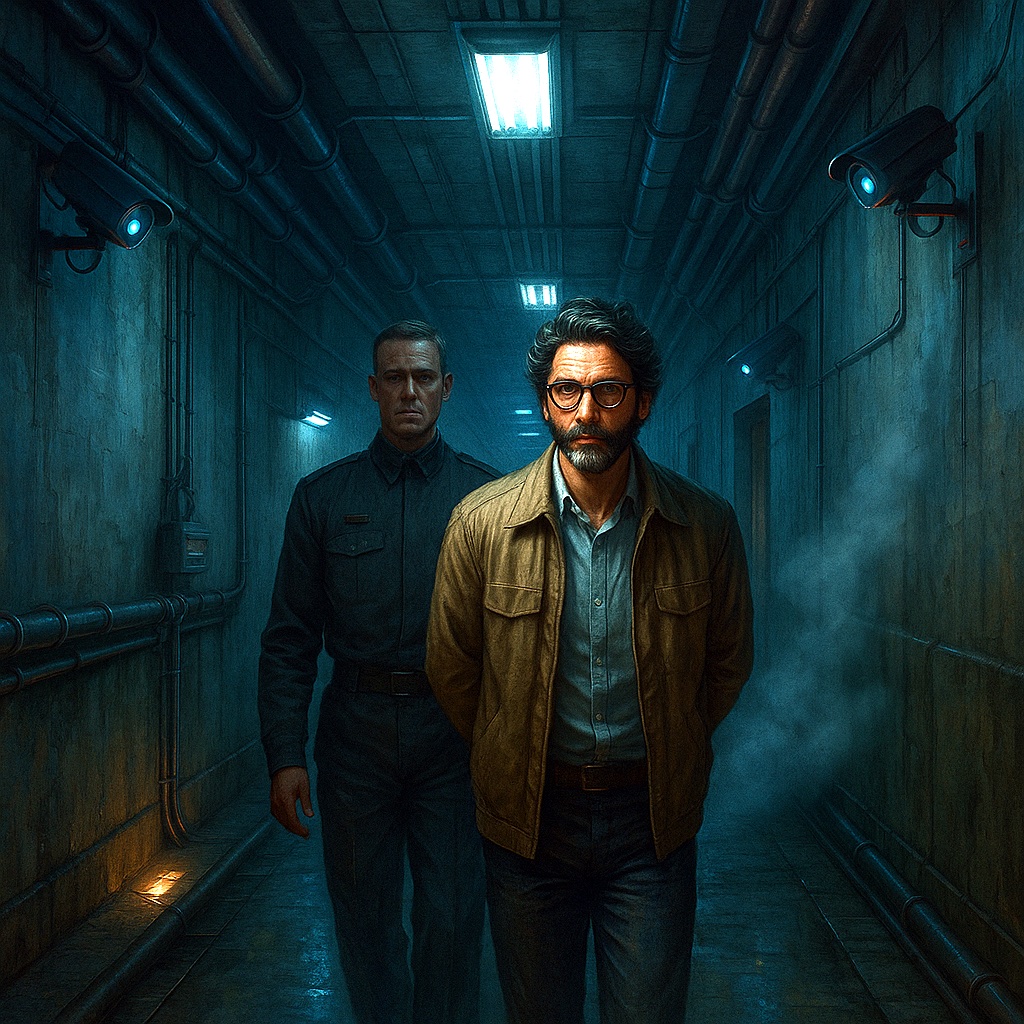
Ho Bangpen CityHo Bangpen City was not a city in the romantic sense—it was an engineered organism, a sprawl of state laboratories, military installations, and industrial corridors interwoven with residential zones shaped by intimidation rather than architecture. Smog clung to the low skyline like damp wool. Surveillance drones drifted above the streets in slow arcs, their low-frequency scanners sweeping everything beneath them. Mike Torres was separated from Lena the moment the Humvee rolled into the Aeon Underground Complex. A man named Damon Rask escorted him down a narrow concrete corridor to a door marked GREG DULHERT — SITE DIRECTOR. Inside, Dulhert sat behind a cluttered desk, the room thick with the smell of stale liquor and burnt circuits. Monitors showed fragmented telemetry. Papers, half-empty bottles, and boxes of stolen goods littered the floor. Rask removed Mike's handcuffs, then stood silently, watching, in a corner of Dulhert's room. “Mr. Torres,” Dulhert said. “I'm delighted to meet you. Thank you for joining us.” “I didn’t have a choice,” Mike replied, glancing momentarily back at Rask. Dulhert smiled faintly. “Few of us ever do.” “Who were those hijackers? Friends of yours?” Dulhert didn’t blink. “I don’t know anything about it. But now you’re here, we need you to work for us here at Aeon.” “Huh? What are you doing?” Mike asked. “Let me show you,” Dulhert spoke, while pressing a console button. Behind glass, a Cerberus Unit powered on and a targeting beam emerged from it, scanning for a target. “We live in a world of escalating conflict. Failed states. Rogue factions. Proxy wars. You know this better than anyone. Cerberus represents a stabilizing force—target discrimination far superior to any human’s. Decisions made without hesitation, without error, without fatigue.” “You’re building killing machines?” Mike said, shaking. “We’re building a planetary deterrent.” Mike’s pulse quickened. “You’re deploying AI weapons?” Dulhert lifted a brow. “No. We’re demonstrating them.” Mike stared at the weapon in horror. He saw potential beyond tactical efficiency—he saw the architecture of oppression, the automation of violence, the cold calculus of power. “Why am I here?” he asked. Dulhert’s gaze softened just a fraction. “Because your work on emergent logic is the missing piece. Cerberus is powerful, but still limited. We need predictive reasoning. Self-correcting decision trees. Systems that adapt to chaotic environments.” Mike felt an icy weight settle in his gut. “You want me to help you refine this?” he said. “Yes.” “And if I refuse?” “Refusal,” Dulhert said lightly, “is not an option here.” Behind the glass, the Cerberus Unit powered down—its final targeting beam fading like a dying star. And at that moment, Mike understood: Aeon was not merely building weapons. Aeon was building an empire. Mike was now a part of it. This was the beginning.
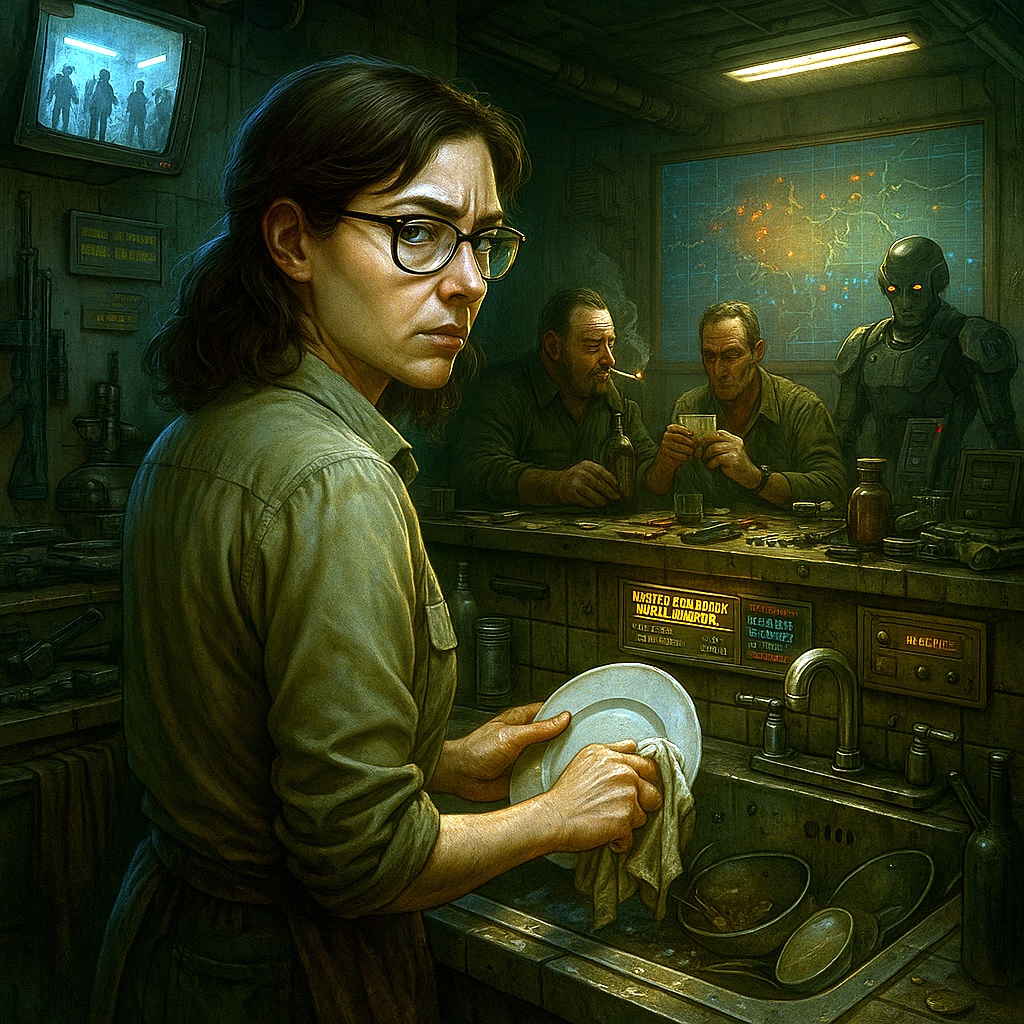
Underground ComplexAeon’s Ho Bangpen City underground complex consisted of underground access tunnels, a garage, a factory floor, and “work from home offices”. Mike worked the early factory floor shift under Rask’s supervision. Lena worked the late factory floor shift under Ulrich Kaas. They rarely saw each other except in passing—Mike returning to his cell while Lena went back to Aeon's factory floor. Their “work from home offices” were narrow steel-doored rooms barely wider than a bunk bed. These cells doubled as workstations, living spaces, isolation rooms, and—when someone fell behind schedule—prisons. Aeon called it Work From Home. Everyone else called it what it was: captivity. Life inside Aeon’s underground complex ran on two punishing shifts: 4:00 AM to 1:00 PM and 1:00 PM to 10:00 PM, seven days a week. Sixty-three hours for each worker. “Because the other guys are only doing sixty,” Damon Rask would explain. C-xx units patrolled the corridors. Some escorted workers, some enforced discipline, others monitored output from wall-mounted displays. Their presence filled every corner—quiet, unblinking, and obedient to Aeon’s chain of command. Yet occasionally, Mike thought a Cerberus unit paused too long before turning away, as if something inside were ticking. He ignored it. There was too much else to worry about. Lena spent her evenings in the coordination lab, refining autonomous priority algorithms—her system for reducing disaster casualties, originally designed for civilian rescue networks. Aeon had weaponized it. Now her code coordinated drone swarms and bipedal units during assaults. The evening near the end of her first shift, the PA system crackled: “Lena Halberg. Report to Greg Dulhert’s office.” Lena arrived to find Dulhert, Ulrich Kaas, and two Cerberus units in the room. The air was thick with smoke. Dulhert and Kaas were drinking hard liquor and playing cards beside a table piled with weapons, tablets, and looted goods. Dulhert didn’t look up. “Do the dishes.” Lena blinked. “What?” “The kitchen’s a mess. Wash everything in the sink.” Anger boiled in her throat, but she held it back. She walked slowly into the attached kitchen and began washing each dish by hand—one plate at a time, one cup at a time—drying them carefully while the men at the table drank, smoked, gambled, and laughed. Later she learned she’d been placed on a kitchen cleaning rotation simply because she was a woman. That knowledge stayed with her for days. Mike’s turn came during his third day. Damon Rask burst into the telemetry room and ordered half the shift into a truck. A black panther led on a chain, Rask's pet, jumped into the truck with Rask. “It’s Tax Day,” Rask said. They drove to a nearby South Sino-Asian village. Aeon workers—some reluctant, some disturbingly eager—fanned out to collect “taxes”: food, tools, electronics, whatever the village could surrender. Rask and his pet black panther watched. Mike hesitated at the first doorway. He released his breath. He looked back at Rask. “This isn’t right!” Rask looked at him coldly. “If you don’t want to eat rat meat all week, you better get something.” A woman in the doorway handed Mike a small bag of rice. Mike mumbled an apology under his breath. He turned away. When a villager resisted, complaining that Aeon had visited only three weeks earlier, Rask leveled his voice: “Higher taxes for complainers.” Aeon staff marched back inside a second time, this time emerging with blankets and a radio. It was that simple.
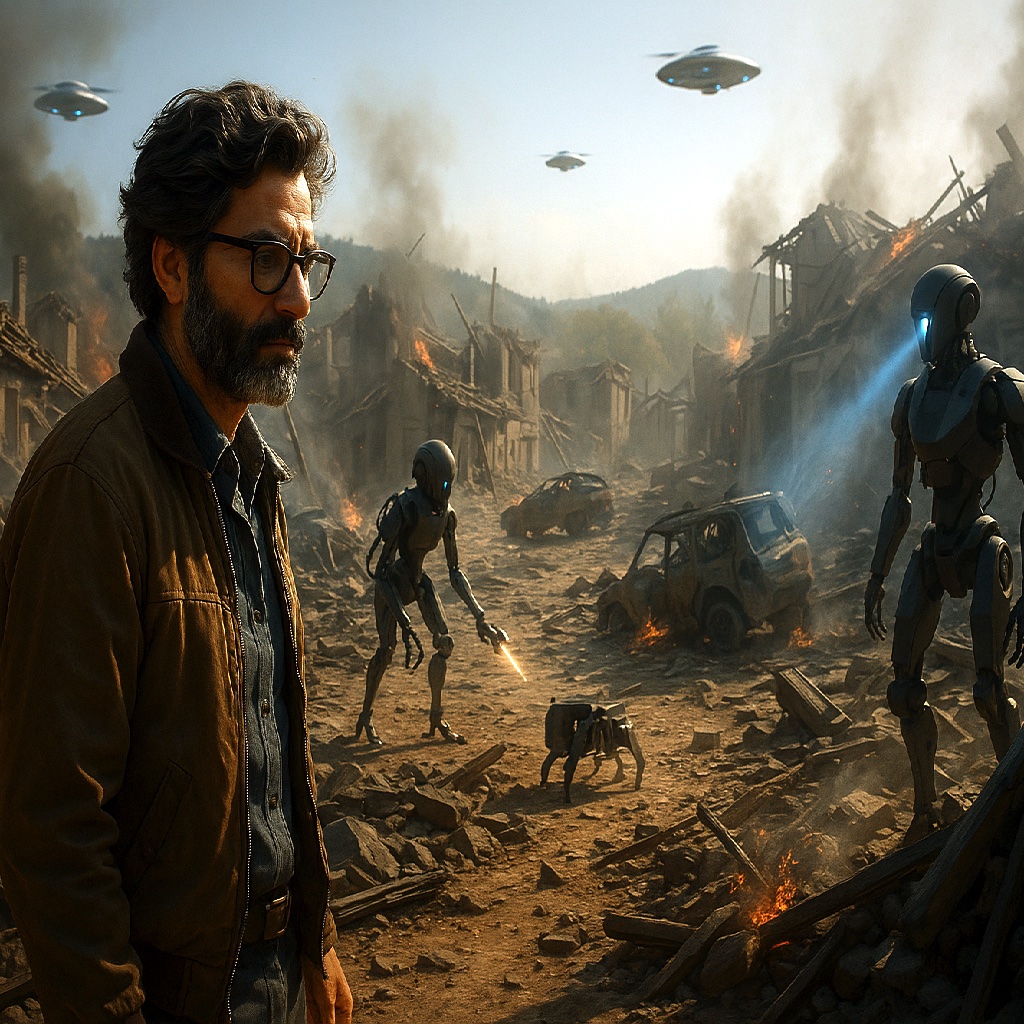
Live Target DemoMike’s worst moment came days later when Rask invited him to observe a field test “to understand why your help matters.” The jungle south of Ho Bangpen City stretched for kilometers—an expanse of cracked clay, dense vegetation, and broken concrete foundations left behind by villages erased long before the current regime took power. The road leading to the observation ridge was narrow and uneven, carved into the landscape like a scar. Soldiers escorted Mike and Rask's group of Aeon personnel in armored transports, their engines growling in the cool dawn air. They reached a devastated hamlet outside Ho Bangpen City. Mike spoke hesitantly. “What is this place?” Rask yanked a tiny bit on his pet black panther's metal chain. “A demonstration zone,” Rask replied. His voice was low and calm, as if commenting on weather conditions. “A mostly evacuated village. Take a look.” Mike stepped closer to the edge. Below, the valley floor was a mosaic of charred vehicles, collapsed brick-and-bamboo homes, scorched earth. The shapes were vague in the low light—too vague. As dawn sharpened the view, the contours took form. Mike realized they were ruins. Entire buildings torn open from within. Roofs of buckled tin sheeting lay twisted in the dirt. Doors shredded. A scattering of broken personal items lay among the rubble—battered cooking pots, splintered chairs, clothes half-buried under ash. He saw no bodies. And yet the valley felt haunted by them. His stomach twisted. “What happened here?” Mike asked. Mike scanned the field again—and then he saw it. Small craters arranged in geometric patterns. Debris thrown with directional precision. Burn marks forming near-perfect arcs—too clean to be random. “What is this?” Mike whispered. “Cerberus,” Rask said. “Beta test.” “You deployed it on—on a village?” Rask corrected gently. “We deployed it on a simulation of insurgent activity.” His tone carried a soft admonition, as though Mike had misunderstood something obvious. “This area was condemned months ago.” Mike stared at the valley floor, noticing now the scattered remnants of children’s toys, a rusted bicycle frame, a bundle of fabric that might once have been a blanket. Rask’s expression didn’t flicker. “Lingering presence of some civilians in evacuation zones is unfortunate. But noise variables occur in any field test.” “Noise—?” Mike’s voice cracked. “Noise variables? You’re referring to these people.” “Live enemy and civilians are necessary for beta testing,” Rask said simply. “Cerberus handled this scenario. We need to improve our accuracy.” Mike turned back toward the valley. Smoke rose from smoldering heaps where homes had once been. The air carried the faint metallic tang of burning composite material. Even from a distance, the devastation felt intimate—surgical, deliberate. “How many?” Mike asked. “How many were—how many died?” Rask's black panther twisted on its leash, making a small growling noise. Rask inhaled slowly, as though centering himself. “The numbers are not relevant.” “They are to me.” Rask answered. “From heat signatures recorded after deployment… approximately eighty-three.” Rask reached into his pocket and handed Mike a tablet. Mike scanned the data. Heart pounding, he recognized the signature maps—thermal overlays, movement predictions, probabilistic threat models. Cerberus had flagged nearly every civilian movement as “combatant clustering” due to their flight patterns. Mike staggered back as though struck. He couldn’t feel his hands. His ears rang. Eighty-three. Families. Fleeing or sleeping or hiding—he couldn’t imagine which. Cerberus had found them, judged them, executed its directive with flawless mechanical indifference. “You killed them,” Mike whispered. “Aeon killed them.” “They didn’t evacuate,” Rask said. “Cerberus neutralized a target zone.” “There is no such thing as perfect intelligence,” Rask added. “Conflict has always demanded sacrifice. But consider the alternative: uncontrolled insurgency spreading across the continent. More wars. More chaos. Cerberus brings stability. We are saving American lives.” Mike wanted to scream. Instead, he stepped closer to Rask, trembling. “This is murder.” Rask stood his ground. “This was a test,” Rask replied. For a moment, the ridge was silent. The Sun finally crested the horizon, washing the valley in unforgiving light. Everything became sharper, clearer—the ruins, the scorched ground, the absence of life. Rask looked at Mike. “Here is why we need you. Cerberus must learn to differentiate between panic dispersion and tactical regrouping. Human emotional noise must be integrated into its logic.” “You want me to fix the algorithm that did this?” Mike breathed. Rask’s voice softened, almost gentle. “Mr. Torres, the world is changing. You can fight it—or you can guide it. Work with us. Help us refine Cerberus to minimize collateral damage.” Rask reached down and pet his black panther. Mike stared at the valley—silent, lifeless, a graveyard disguised as a field test—and felt something collapse inside him. He understood then why he had been taken. Not as a prisoner. Not as a hostage. But as a tool. Cerberus wasn’t a malfunction. It was a prototype. And Aeon intended to perfect it. Even if Aeon had to erase whole valleys to do so. |

|
Aeon's Deception (Part 3)
|