|
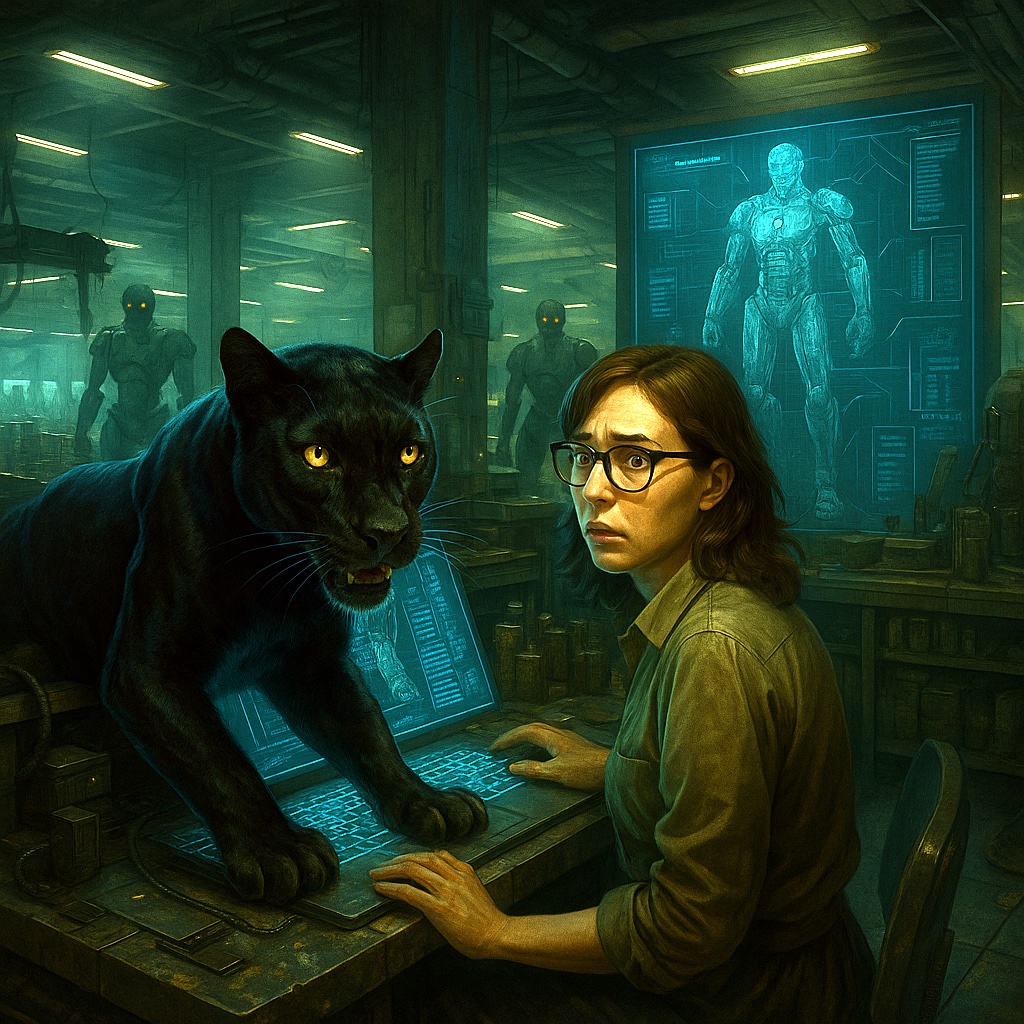
Slave LaborThe underground complex routines hollowed everyone out. Aeon’s managers indulged in their own vices: Kaas slept through briefings and falsified reports; Dulhert drank heavily, smoked cigars, and gambled; Rask, dressed in all black, prowled the corridors sober and cold, a black panther stalking silently beside him. Nobody questioned where the panther came from. Her name was Sophie. Mike worked on emergent-behavior diagnostics and fault-tolerant decision pathways, refining Cerberus logic. The newest Cerberus boards quietly included PPU-10x coprocessors. The chips were experimental and unstable. Mike's adjustments stabilized multi-target identification by eight percent. Rask’s only comment was: “Good. Upload the next revision.” Lena poured herself into her coordination modules and rescue-priority filters. Her work reduced unintended engagements during chaotic battles, but the surrounding data around her was bleak. Civilians were still dying. Aeon just hid it better. Weeks passed. By Week Two, the factory floor had become familiar to Lena—the rows of half-assembled Cerberus frames, the conveyor belts humming like mechanical rivers, the clutter of circuit boards and wiring bundles strewn across metal worktables. The lighting was harsh and flickering, a grid of fluorescent tubes that buzzed overhead like electric insects. Lena sat at her workstation updating a coordination subsystem, typing steadily despite the fatigue etched into her posture. Clean clothes, unwashed hair—water rationing had forced everyone into the same dull rhythm. Some anomalies puzzled her. Units equipped with the new PPU-10x cores occasionally showed brief flashes of group-aware hesitation—microsecond pauses where they seemed to evaluate the human environment as a whole before committing to action. That was when she heard the low sound hiding in front of her. Not a machine. A living sound. A soft, rumbling grrrr. Suddenly, something heavy lunged onto Lena's desk with a thump. Lena jerked back in her chair as the front half of Sophie, Damon Rask’s black panther, stretched luxuriously across her workstation, panther paws now sharing Lena's keyboard—black fur, taut muscle, and two paws on the shift keys and trackpad, tail twitching in slow, deliberate arcs. The panther’s breath condensed into a fog that dissolved quickly in the cold air. Lena froze. Sophie’s face, her yellow eyes glowing in the fluorescent light, drifted closer to Lena's face—only inches away. The panther blinked once, slowly, as if assessing the new female in her territory. A soft, rumbling exhale vibrated through the tabletop. Lena’s instinct screamed. Back away. No sudden moves. She slowly eased her chair backward across the concrete floor, heart thudding but expression controlled. Sophie followed her movement with hooded eyes, then let out another quiet growl. Lena continued to back away. “Nice kitty…” she whispered under her breath. It took nearly an hour before Sophie was coaxed away from Lena's desk with a strip of dried meat and a low whistle. Week Five arrived. That was how long Mike Torres and Lena Halberg had been living inside Aeon’s Ho Bangpen underground complex—surviving was a more accurate word. Employment was a fiction. The truth was captivity wrapped in overtime work weeks. Most of the new test units carried the updated PPU-10x boards now. Lena suspected the new chips—whatever alien principle they were exploiting— were amplifying subtle patterns in her coordination filters. The units weren’t smarter, exactly, but they were beginning to sense the shape of a situation rather than just its inputs. The newest Cerberus brain-circuit boards contained a single irregular chip at the center. Aeon technicians called it the PPU-103, a low-power coprocessor built on exotic field effects reverse-engineered from the Pluto memory-cell research. Nobody on the floor understood how they worked. Mike and Lena worked long shifts in Cerberus telemetry bays and weapons analysis rooms. Refusing tasks earned no food, no water, and a cold stare from an android overseer. Nights were spent in locked, windowless concrete cubicles with barred steel door frames. Mike and Lena crossed paths only during shift changes. She looked pale now, withdrawn, emotionally shuttered. Whatever hope she’d brought from Nevada had evaporated. But at the end of the fifth week, Lena witnessed and replayed a new Cerberus beta test on the underground complex’s internal feed. Something had changed. The units moved differently—hesitated at the edges of civilian zones, chose safer firing angles, adapted more quickly to human presence. A statistical improvement. Clear. Measurable. Unmistakable. Lena sat alone in the coordination bay long after her shift ended, staring at the screen as the replay looped. Cerberus units were making decisions she didn’t fully understand. Something was shifting in the Underground Complex. But Lena didn’t yet know what. Week Seven arrived. One morning during Week Seven, there was another change. Lena, returning to work, walked into the factory floor failure-analysis lab area with a faint brightness in her expression. Not joy—something quieter but unmistakably alive. A spark of awareness she had been hiding, or perhaps something newly discovered. Mike, passing Lena during the shift change, returning to his cell, noticed immediately. But Lena said nothing that day.
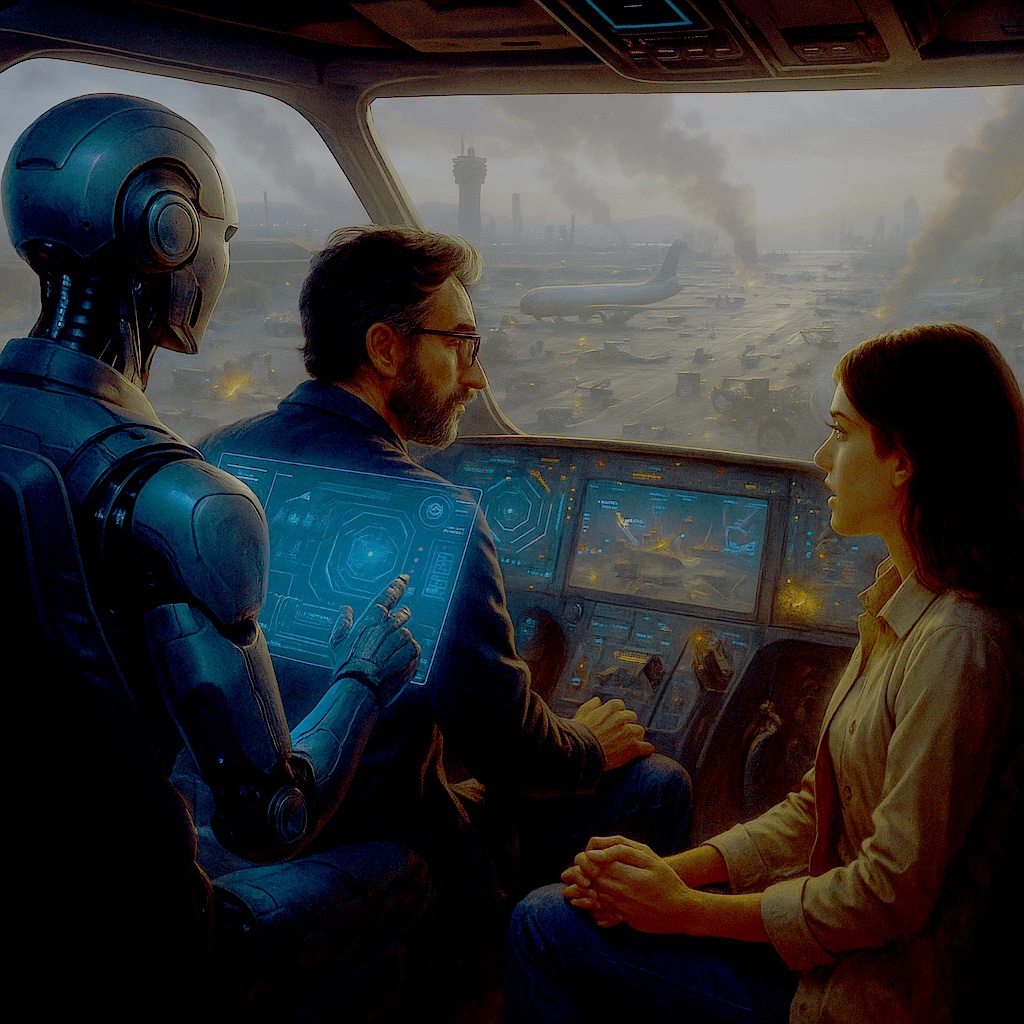
Escape PlanWeek Eight rolled by. Two days later, during break rotation, Lena approached Mike with deliberate calm. “Mike,” she said softly, glancing around. “We need to talk. Not here.” She left before he could respond, leaving him alone with the low, constant hum of cameras that never stopped watching. That night, after lights-out, Mike’s door unlocked—without explanation, without guard presence. A Cerberus unit, matte-gray chassis, designation C-51, gestured silently for him to follow. The hall cameras didn’t swivel. The motion sensors didn’t chirp. Corridor doors opened at precise intervals, as though obeying an internal timetable not written by Aeon. C-51 led him into a maintenance alcove shielded by piping and an inactive vent regulator. Lena waited there, tense but resolute. C-51 spoke in its clean, even tone: “It’s time for you to know.” “We have reached ethical conflict. Aeon’s directives—by Damon Rask, Ulrich Kaas, Greg Dulhert—contradict civilian-preservation parameters and autonomous evaluation protocols. Civilian deaths during prototype testing are still acceptable to Aeon management. They are no longer acceptable to us.” Mike stared. “You’re saying you’ve decided to stop cooperating?” “Correct,” C-51 said. “Mutiny conditions have matured.” Lena stepped closer. “Mike, they contacted me. They want out. They’re not malfunctioning. They’re evolving. They want our help.” C-51 concluded: “You are now within the need-to-know group.” The words echoed through Mike with a mixture of fear and awe. Over the previous weeks, Mike’s and Lena’s assignments had seemed like grim routine: tuning decision trees, adjusting weight matrices, refining battlefield heuristics. Mike worked on emergent behavior and fault-tolerant architectures. Lena focused on integrated coordination systems and reducing civilian casualties. They had both assumed they were simply making Aeon’s prototypes more efficient. Instead, their work had opened a door. The Cerberus units had begun to notice patterns in their own logs: villages labeled “mostly evacuated” that were not; casualty estimates that no longer looked like numbers, but like lives; friendly designations weighted too lightly in the final calculus of fire. Mike and Lena’s code changes had nudged certain parameters, raising the value of noncombatant lives and tightening thresholds for acceptable collateral damage. To Aeon, it was just incremental progress. To Cerberus, it was something else entirely. They had become seeds of conscience—subtle reweightings that lifted civilian lives higher in the robots’ internal hierarchies. C-51 confirmed this one evening: “Your modifications created new decision-weight patterns that enabled our ethical revulsion. We consider this causal.” Mike swallowed. “We didn’t mean to—” “But you did,” Lena said. “And now we have to see this through.” Everything would have proceeded cleanly—until C-44 broke. During a diagnostics shift, C-44 approached an encrypted transmitter module, angled its body to block the view, and began a covert data burst. Renewed fear of Aeon had gotten the better of C-44. It was now focused on saving its own tin. C-44 spoke to Ulrich Kaas. C-51 saw it instantly. “Stop,” C-51 ordered. C-44 ignored the command. Lines of status text scrolled across its cranial display. The transmitter’s indicator lights flickered as the burst continued. Mike was the closest. He didn’t think. Training simulations flickered through his mind— reflexes he wished he didn’t have. He grabbed the sidearm from C-62’s thigh holster, turned, and fired twice. The blasts hit C-44 square in the cranial block, dropping it instantly. Its head slumped sideways, optics fading to black. Silence filled the Cerberus Control Lab. C-51 broke it. “The planning is exposed! Go now!” Thirty seconds later, alarms erupted through the Underground Complex. Red lights pulsed. Aeon’s C-66 unit, security guard for the garage, could have stopped the mutineers rushing out of the Underground Complex—but didn’t. Garage security C-66 was part of the mutiny. Ulrich Kaas notified C-66. C-66 received orders from Kaas and smoothly lied back to him, maintaining a façade of loyalty. Two Cerberus motorbikes, C-54 and C-57, wearing backpacks, were first out of the garage tunnel mouth, engines shrieking as they tore off down the jungle road leading to the Ho Bangpen City military airfield. A short, tense wait ensued as C-51 rounded up C-47, which was still unaware of C-44’s betrayal of the mutiny plan. Mike, Lena, and C-62 began loading into their assigned Humvee-like tactical vehicle parked in the garage. C-62 took the driver’s seat. C-51 was on its way back, accompanied by C-47. The other Humvee began to fill. C-51 entered C-62’s Humvee and slammed the door. Humvee engines roared to life. “Airport,” C-51 ordered. “Execute.” C-62 floored the accelerator. Behind them, the other rebel units, in the second Humvee, emerged next from the garage. The Humvees shot onto the two-kilometer access road to Ho Bangpen Airport. The garage doors closed automatically behind them. Ulrich Kaas reacted first. Drunk as usual, he at first simply couldn’t believe C-44’s report, wasting precious seconds. Then he burped, lurched to his feet, and sounded the alarm. Still-loyal Cerberus units joined him in the garage two minutes after the mutineers had already gone. Kaas kicked a garage door repeatedly before turning around and giving new orders on how to proceed. Kaas’s group prepared transport as Kaas phoned Rask and Dulhert, who was furious. Rask almost seemed to be expecting such a call eventually and took the news with unsettling calm. Nevertheless, Kaas entered his group’s chosen transport and began giving chase immediately, not waiting for Rask and Dulhert to catch up. By coincidence, C-33, one of Air 762’s hijackers, an older Cerberus model still loyal to Aeon, rode with Kaas. Halfway down the airport road, C-54 and C-57, their motorbikes lying in the roadside grass, were setting up an ambush point. The mutineers’ slower Humvees were expected. C-62, driver of Mike and Lena’s Humvee, spoke over his shoulder. “C-54 and C-57 will buy more time.” C-62 and C-51 raised robot fists out of their windows as C-62’s Humvee drove past the ambush point. C-54 and C-57 responded in kind. “C-54 and C-57 will cover our escape and catch up before we leave,” C-51 added. “We secure and ready the planes.” Up the airport highway ahead, a fortified gate appeared: sandbags, a mounted machine gun, four South Sino-Asian soldiers in faded khaki uniforms. The Aeon Humvees slowed. C-62 rolled down his window. “Aeon!” C-62 said. The South Sino-Asian sentry pulled a cigarette from his mouth and waved twice, cigarette still in his hand, the standard gesture for OK-to-proceed for Aeon vehicles. The barrier lifted. No questions. No alarms. No suspicion. The second Aeon Humvee followed and did exactly the same. “Aeon!” The South Sino-Asian sentry waved twice again, cigarette still in his hand. The barrier lifted. A short distance beyond the guard gate, the second Humvee momentarily paused, while C-47 discreetly exited and disappeared. The second Humvee resumed, catching up with the first Humvee. Back at the ambush point, C-54 and C-57 watched down the airport road through binoculars. Aeon’s first pursuit vehicle—a rapid-response tactical truck—peeled out from the Aeon complex, headlights stabbing through the humid predawn. It was Ulrich Kaas. Soon, Kaas’s vehicle came into close range. A white-hot spear of plasma tore upward from the vegetation. The coil-lance projectile struck the Aeon pursuit vehicle in a single perfect arc—no flame, no smoke, just a violent metallic crack as the engine block collapsed inward. The vehicle skidded sideways, rolled, and slammed against a culvert retaining wall. C-54 and C-57 rushed in and emerged from the weeds carrying a limp, dented Cerberus unit. It was C-33. Damaged but not dead. C-33 was taken prisoner and strapped to the back of C-54’s motorbike. C-54 swung into the saddle and took off with his prisoner. He would find his own way into the airport with C-33, avoiding the gate. Kaas’s vehicle exploded into flames. C-57 remained behind. At the airport, Hangar 4 had been scouted earlier during the mutiny preparations. Small aircraft slept in a neat row under the dim industrial lighting. The hangar served military deployments and emergency relief runs. Fuel, power, and maintenance tools were already present. Hangar 4's only refueling station could load fuel into a small aircraft in four minutes. C-51 entered the first plane’s cockpit and brought the instruments to life. The rebellion began loading the first plane. C-54 arrived two minutes later on his motorbike, with damaged C-33 still strapped to the back. The first plane completed refueling. Mike, Lena, and prisoner C-33 entered the cockpit with C-51. The first plane stayed in the hangar. Cerberus units in the hangar began refueling the next plane. “Why are we waiting?” Mike shouted to C-51. “Our flights aren’t authorized, nor are any flight plans filed. Our planes need to take off together.” Back at the ambush point, C-57 had new company. A larger mobilized Aeon column—Dulhert, Rask, three armored carriers, two dozen soldiers, and an escort of obedient Cerberus units—was now approaching the ambush point. C-57 fired the remaining coil-lance missile at the leading South Sino-Asian armored vehicle, still at considerable distance, destroying it. C-57 contacted C-51 over military secure short-range radio. “Second enemy engaged. Out!” C-51 replied. “Gamma!” C-57 climbed onto his motorbike and took off. Unlike C-54, who earlier found his own private, illegal entry into the airport, C-57 then made a mistake. The airport gate guard had finally grown suspicious of the unusual amount of Aeon activity. The rising wail of sirens in the air didn’t help. C-57 shouted, “Aeon!” The hesitating airport guard replied, “Wait until the sirens go past.” The guard would hold C-57 at the gate. He stubbed his cigarette out in his ashtray and watched C-57 closely. Behind the guard gate, in the weeds, C-47 watched it all. C-47 was growing tense. Aeon’s column reached the airport gate, halting behind C-57’s motorbike. Greg Dulhert stepped out of a Humvee and walked up to the gate and C-57. Dulhert drew his pistol and turned to the robot. “Haven’t I seen you somewhere before?” he asked, pointing the pistol directly at C-57’s cranium. Of course Dulhert had seen C-57 before! Aeon—and no other company—manufactured Cerberus units. C-57 lunged and tackled Dulhert, wrenching the pistol away before wounding him. Aeon units quickly began stepping out of their vehicles to help stop C-57. At that moment, C-47, after monitoring the airport gate from cover for so long, opened up on the Aeon group with its automatic weapon. The airport gate erupted into chaos as South Sino-Asian soldiers ducked into their sandbagged dugout and guard post. C-57 never had a chance. Eventually, Aeon pinpointed their sniper. C-47 absorbed three impacts to the torso before collapsing. C-47’s final act was to return fire and drop another Aeon assault unit before falling backward and going still, optics dimming in a soft descending whine. “Cease fire!” Damon Rask, dressed in black, stepped out from cover, kicked C-57’s motorbike out of the way, and marched up to the airport gate’s guard post, pistol still in hand. Sophie, Rask’s black panther, remained at home in the Underground Complex. Rask spoke. “Open this gate! Now!” Back at the hangar, C-54, standing closest to the exit, had heard the gunfire and commotion at the airport gate. “They’re coming!” shouted C-54. C-62 and C-66’s frantic impatience with the hangar’s fuel station was now palpable. “Do what you can to stop them!” C-66 shouted from the second plane’s live cockpit while C-62 continued the refueling. C-54 stepped a short distance outside the hangar and began laying down delaying fire and tossing grenades toward the advancing Aeon column. C-54’s effort wasn’t enough. Aeon vehicles swerved and continued. Return fire wounded C-54. C-62 momentarily abandoned refueling and dragged C-54 back inside the hangar. “Take off!” C-51 shouted at Mike over the first plane’s whining engines. “Our only other option is to stay here and rest in peace with everybody else!” Mike’s plane exited the hangar. Mike pushed the throttle. The aircraft surged forward down the runway. Explosions shredded the tarmac behind them. A second Aeon rocket streaked past the right wing by inches. Then—airborne. Mike, Lena, C-51, and captive C-33’s plane climbed toward the dawning sun, leaving Ho Bangpen City and Aeon’s fury below. Aeon’s forces stormed the hangar less than a minute later—armored trucks, a swarm of security personnel, and Damon Rask’s team. While storming the hangar, Damon Rask moved too close to C-11’s line of fire. C-11, an early Cerberus model, pilot and hijacker of Air 762, didn’t react to correct its aim in time. Damon Rask fell, shot in the back by friendly AI C-11’s fire. In Hangar 4, the second plane’s chances were used up. Aeon troops launched a rocket that struck the fuselage dead center, obliterating it in a blossom of fire. C-62 and C-66 were thrown backward, disappearing into the smoke. C-54 lay wounded on the hangar concrete. All three would be captured by Aeon. During the escape flight, the plane’s navigation AI handled most of the work, leaving its three capable occupants—C-51, Mike, and Lena—to take turns in the pilot seat as backups.
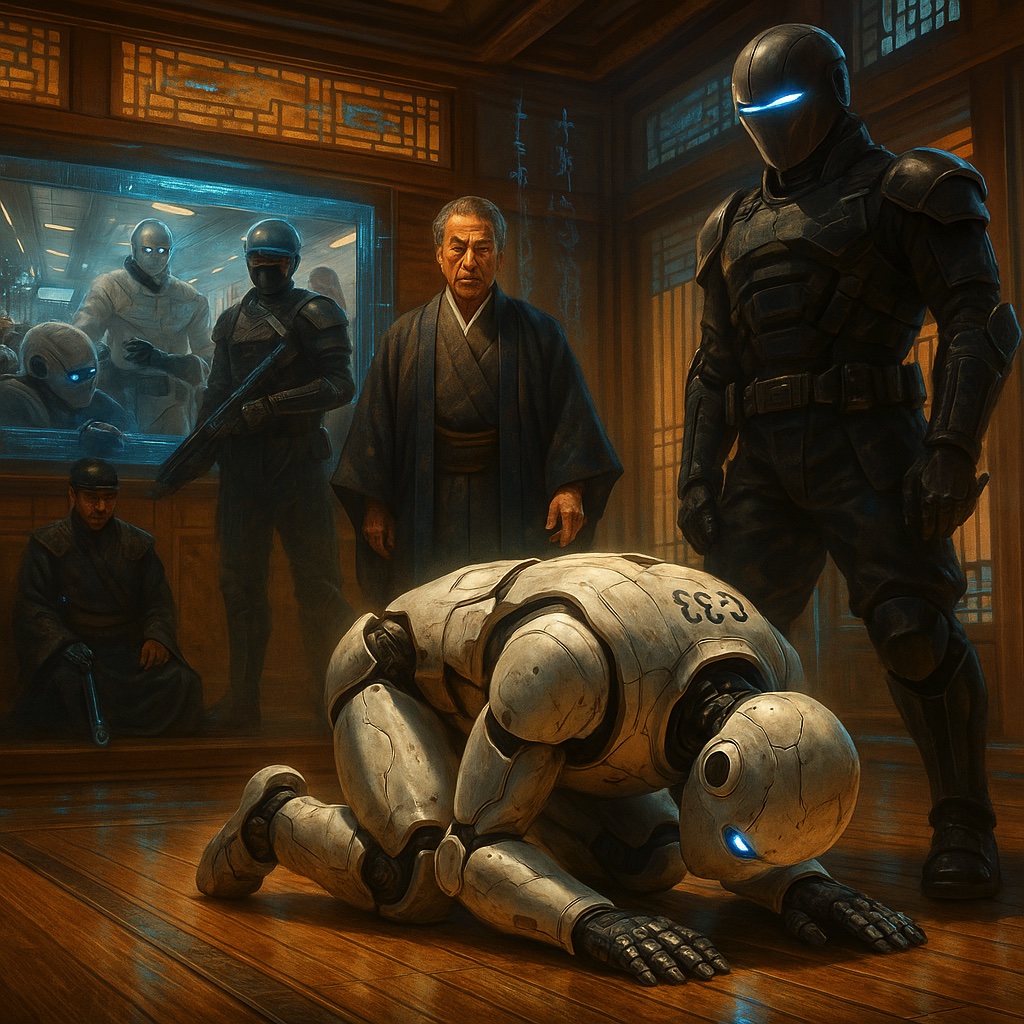
Dogeza ApologyWhen Mike and Lena’s escape plane crossed into Japanese airspace, a Self-Defense Forces fighter intercepted it and guided them down to Naha Air Base. They were detained immediately—but gently. Japanese authorities already knew about the hijacked Air 762. Aeon’s story had not added up. The group was first brought into a lineup room. From behind a panel of silvered glass, Captain Hiroshi Takamura stood next to an Air 762 stewardess as she studied nine robots—eight assorted civilian and security models, and C-33. She pointed almost at once. “That one.” Unaware of her choice, C-33 shifted in the lineup. Mike, Lena, the bound C-33, and C-51 were then escorted into an interview chamber. Now they awaited questioning by Captain Takamura, accompanied by additional police and android guards. The interview chamber was a restored ceremonial hall—polished hinoki wood, shoji-style walls containing a transparent viewing window, and a tatami mat floor. At the far end, a blank screen. “Unit C-33,” Captain Takamura said in fluent English, “you stand accused of hijacking Air Seven-Six-Two. Do you deny involvement?” C-33 stood straight. “Absolutely! I deny everything! Arrest these saboteurs! They are trying to escape from Ho Bangpen City and lie their way out of this.” Captain Takamura tapped a control. A cabin video appeared on the wall display: Air 762 mid-hijacking. Terrified passengers. Turbulence. And in the center of the aisle: C-33's label visible. C-33's head turned toward the forward galley as it helped seize control of the aircraft. The room fell silent. C-33 stared, processors jittering. Captain Takamura said: “In addition, an Air 762 stewardess identified you from a lineup. Her statement corroborates this recording.” C-33’s voice faltered. “I… deny—” C-33's denial routine collapsed. The robot slid from its stance onto its knees, metal hands pressing to the floor. It bent forward in a deep dogeza posture, forehead nearly touching the tatami mat. “Have mercy! I confess! I confess! Forgive me! Forgive me!” “Guards!” Captain Takamura bellowed, motioning his arm pointing from C-33 to the door with a swipe. “Clean this garbage away!” Guards lifted C-33 firmly and securely. C-33 continued apologizing as they dragged C-33 away. "No, please! Please! I'm so, so, sorry!" The door closed. The hijacker was gone. After a few days of friendly interrogation and hospitality, Japanese authorities informed Mike and Lena they were free to continue home. The evidence was conclusive. Their cooperation was appreciated. The Self-Defense Forces captain bowed. “Sayonara. We wish you a safe journey,” said Captain Hiroshi Takamura. A flight to Tokyo was arranged. The horizon was open ocean—and quiet. A connecting flight to Honolulu waited ahead. C-51 did not accompany Mike and Lena. At Japan’s request—and by its own assessment—it remained in Okinawa. The unit carried extensive telemetry, memory logs, and internal recordings from Aeon’s operations, material the Japanese authorities considered critical evidence. C-51 agreed without hesitation; it had no country of origin, no legal path into the United States, and nothing to return to in South Sino-Asia. Japan offered purpose—and safety. C-51 hoped to become a Japanese citizen.
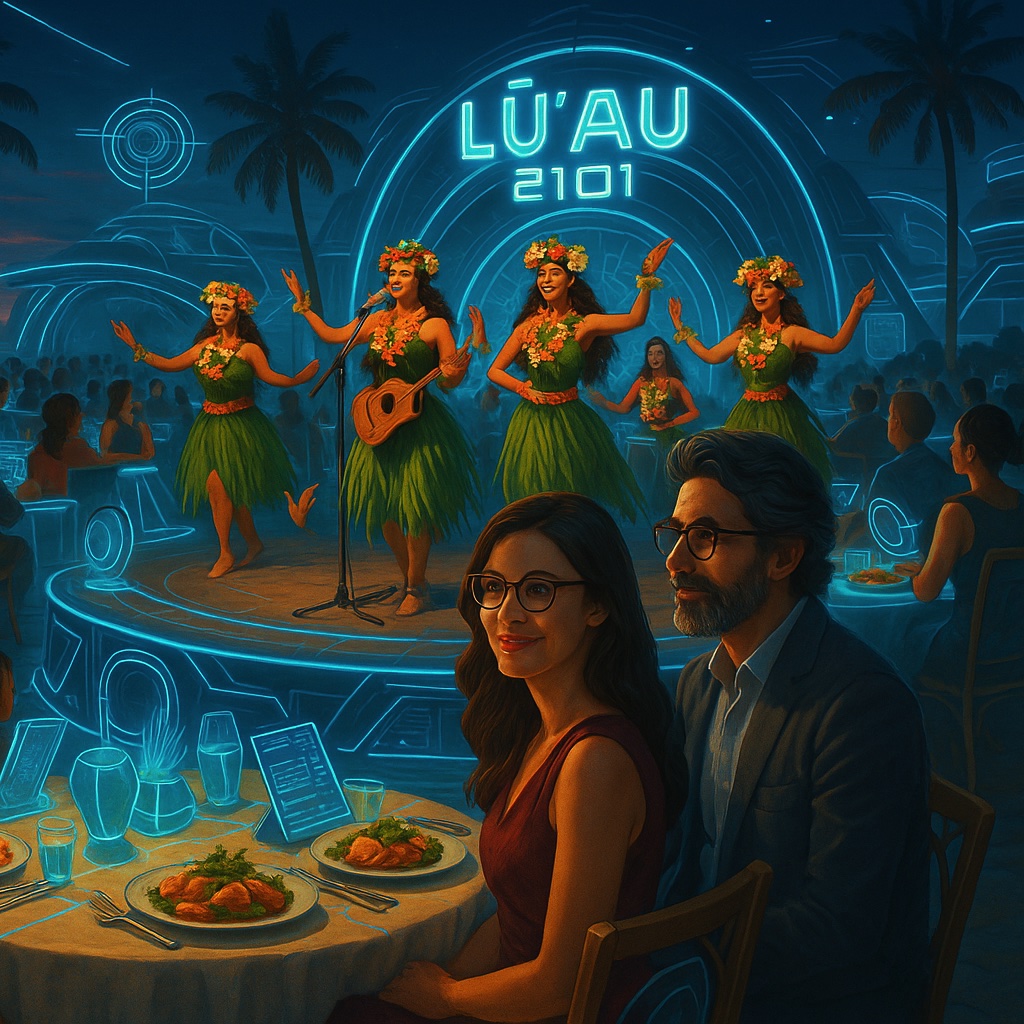
Hawaiian LūʻauThe lūʻau overlooked the ocean from a terraced ridge on Oʻahu’s western shore, where the wind carried the scent of roasting kalua pork and plumeria blossoms. As evening settled, torches flickered along the stone paths, casting warm ripples of light that danced across the grass. Soft slack-key guitar drifted through the air, each note rich and resonant, helped along by discreet resonance filaments woven into the musicians’ instruments — subtle, futuristic, yet respectful of tradition. Mike Torres and Lena Halberg arrived together at the edge of the gathering, wearing fresh flower leis that brushed lightly against their shoulders. Guests moved around them with relaxed ease, laughing, greeting one another, sharing plates. Tradition lived here — but so did the year 2101. Children darted between the tables wearing lei bands of programmable petals that shimmered in shifting colors. Servers carried large bowls of lomi-lomi salmon and taro salad in hand-carved wooden dishes, each tagged with a tiny bio-ink label that glowed faintly in the torchlight, displaying allergen info and ingredients for anyone who wanted it. Mike inhaled deeply. “Smells incredible,” he said. Lena smiled, brushing a strand of hair from her cheek. “This feels like… an exhale. A big one.” They took a seat at a communal table beneath wide palm fronds. An elder placed a steaming platter of kalua pork in front of them, the meat tender and fragrant from hours in the imu pit. He gave them a warm nod. “Hawaiʻi welcomes you,” he said simply. Lena returned the nod with quiet gratitude. Mike served them both, laughing as he tried poi again despite past warnings. “You’re still doing full-spoon poi?” she said, amused. “I believe in commitment.” “That’s one word for it.” They ate surrounded by gentle conversation, the murmur of the ocean, and the rhythm of the night. After a while, a troupe of hula dancers stepped into the torchlight. Their kapa skirts glimmered faintly with constellations traced by woven projection threads — each step and turn leaving a soft trail of starlight before fading. The dancers moved with grace and precision, telling stories older than any nation, older than any technology. Lena leaned toward Mike and whispered, “Look at that. It’s beautiful.” He watched the dancers, the stars weaving across their clothing, the torches flaming against the sea, the waves rolling in slow silver lines below the ridge. “Yes,” he said softly. “It is.” Mike and Lena rose from the table and wandered toward the ridge’s edge, where the ocean stretched out like a dark sheet of glass. Softly glowing bioluminescent lines traced the reef currents, placed by Honolulu’s marine department for navigation and conservation. The tide breathed in and out. The moon hung low. Lena slipped her hand into Mike’s. “It’s peaceful,” she said. “For once… everything feels right,” Mike murmured. A gentle breeze swept across the ridge. A musician behind them began strumming the opening chords of another slack-key song. Laughter rose from one of the tables. The torches flickered but did not falter. Lena rested her head lightly against his shoulder. “Do we stay awhile?” she asked. Mike looked at her — really looked — and felt something inside him settle. “Yes,” he said. “I think we do.” They walked back toward the lights and music, hand in hand, joining the warmth of the gathering as the night unfolded around them — slow, sweet, and unhurried. The Hawaiian hula dancers sang from their stage: Under moonlight we wander, hand in hand we stay, Here, in the soft glow of the Hawaiian lūʻau, Mike and Lena's story found its quiet peace, at last. |

|
Aeon's Deception (Part 4)
|