|
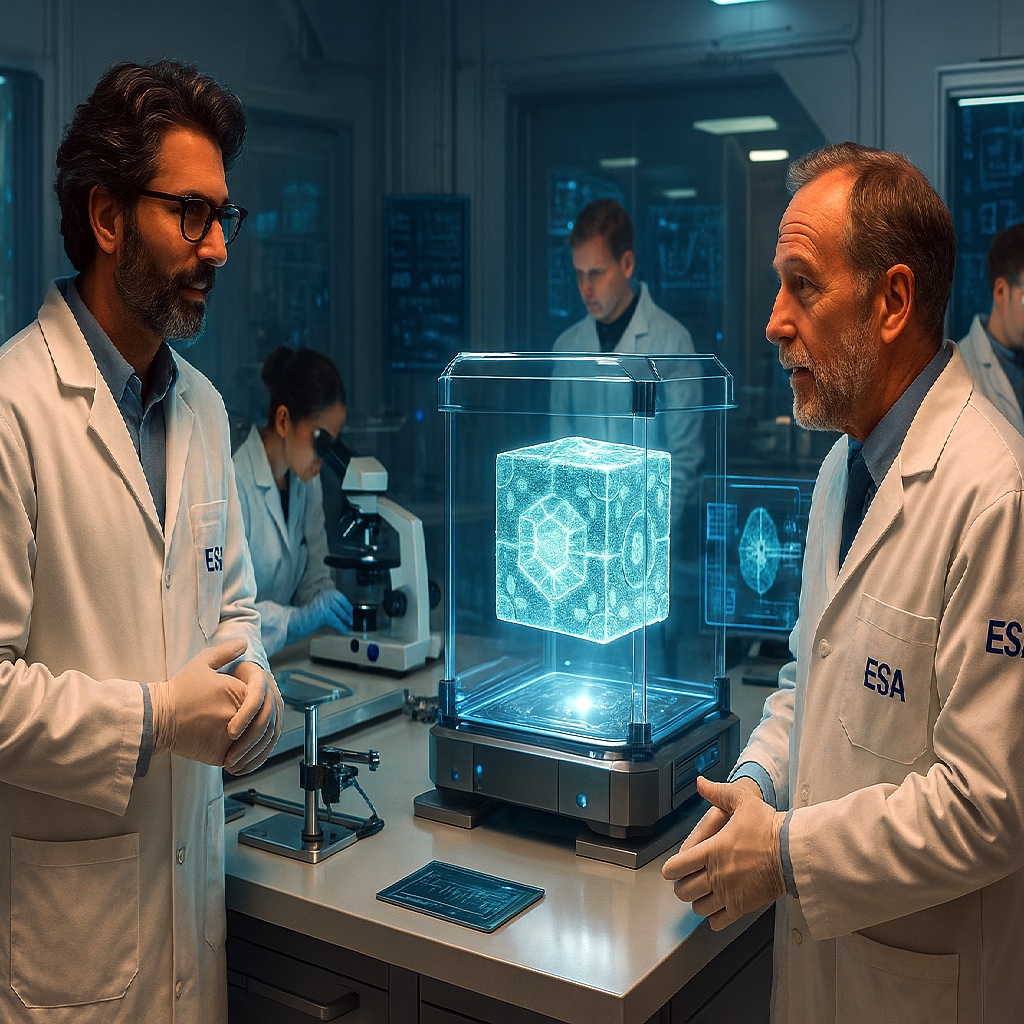
Munich ESA LabThe Munich ESA–LMU Joint Quantum Materials Center stood on the outskirts of the city, a sequence of glass-and-steel structures arranged around a central courtyard like crystalline wings. At dawn, mist drifted low over the Ismaninger Feld. The buildings shimmered faintly in the cold Bavarian light, their faceted façades catching the glow of the rising sun. Mike Torres stepped out of the electric shuttle and drew a breath of frigid air. Winter here was crisp and honest, the kind that smelled faintly of snow even when the sky was clear. The center's main entrance recognized his badge and slid open with a soft magnetic sigh. Inside, everything was quiet. Not the sterile quiet of corporate research centers, but the anticipatory hush of a cathedral built to contain phenomena the human mind could barely grasp. The Munich labs were the domain of fundamental science—the place where humanity’s best physicists, chemists, and computer theorists attempted to decipher matter that refused to obey established laws. “Guten Morgen, Herr Torres,” the man said with a polite nod. “Willkommen im Zentrum.” Mike returned the nod. “Guten Morgen. Danke.” “This way, bitte.” The researcher guided Mike down a corridor lined with glass walls. Each room was its own universe: optical benches buried in lenses and adaptive mirrors; cryogenic glove boxes shimmering with cold nitrogen halos; racks of superconducting qubits suspended in vacuum hoods; exotic probe arrays cooled to fractions of a kelvin by gravimetric dampers. In the far distance, the soft flutter of laser shutters opened and closed like mechanical eyelids. At last, they reached Lab 7, where the Pluto artifacts were housed. The room was dim, illuminated by thin blue strips of indirect light. Three scientists stood clustered around a levitated containment cell — thin, transparent, reinforced with polarizing fields. Inside the cell hovered the object that had changed their understanding of physics. The cube. A matte-black polycrystalline block, covered in faint, recursive surface patterns visible only when illuminated by coherent light. It drifted above its cradle, apparently indifferent to gravity, vibration, or the presence of observers. “Thank you for coming, Mr. Torres,” said Dr. Marius Breuer, the lead physicist—compact, bespectacled, with the tense energy of someone living on the edge of paradigm shift. “We read your notes from the Pluto–Charon AI logs. Fascinating material.” “I wanted to understand what we missed,” Mike said. “The ship AI saw patterns we couldn’t.” Breuer gestured toward the glowing apparatus surrounding the cube. “We believe the structure interacts with vacuum states. Not the quantum vacuum described in twentieth-century physics—something deeper. A structured vacuum. There are oscillations that don’t correspond to any known field excitation.” One of the researchers, a young woman in a white lab coat adorned with Ludwig Maximilian University insignia, added: “When we scanned it with superconducting interferometric lines, we detected a phenomenon we’ve started calling nonlinear phase entanglement drift.” Mike blinked. “Which means…?” Breuer smiled thinly. “Which means the object is communicating with itself across spacetime intervals. The interference pattern isn’t local. It’s referencing its own state somewhere—or somewhen—else.” Mike studied the cube. “What computational models have you run against its output patterns?” Breuer inhaled slowly. “We tried ship-grade optical spintronics. We tried fourth-generation quantum annealers. We even tried field-state compilers built on vacuum-folding algorithms.” “And?” Breuer shook his head. “It outperforms them. At passive rest.” The LMU researcher’s voice lowered. “We believe it may be operating on… prequantum variables.” Mike frowned. “That’s theoretical.” “In 2101, maybe,” Breuer said. “In 2151, perhaps not.” Breuer paused at an ESA pulse sequencer control panel next to the Pluto cube. He set the beam to low intensity and motioned to Mike. “Try it.” Mike used the sequencer to apply a recurrent evolving pattern he sometimes used to stress-test AI subsystems. Breuer moved to the analysis screen. His expression shifted. He glanced at Mike. “No periodic stimulus has ever produced that,” Breuer finally said. The lab group ate lunch at a Wirtschaft on the edge of the Feld — low-ceilinged, warm, smelling of woodsmoke and simmering stock. The food arrived without ceremony: a board of dark Roggenbrot with a crock of Obatzda, the Bavarian cheese spread pungent and yielding with flecks of paprika; warm Brezn with crusts salted and glistening; a bowl of Leberknödelsuppe for Mike — clear, deeply savory broth, the meat dumplings dense and soft. Breuer's Schweinshaxe arrived last, a whole roasted pork knuckle with skin crackled dark and brittle over pale falling meat, accompanied by a shared liter of Hefeweizen. Breuer folded his arms. “Mr. Torres, your familiarity with emergent logic might give us another way to interpret the cubes’ feedback patterns. If the cubes compute through field-state resonance rather than discrete qubits, we need a new theoretical model.” Mike nodded slowly. Munich was the beginning. Mike was ready to help.
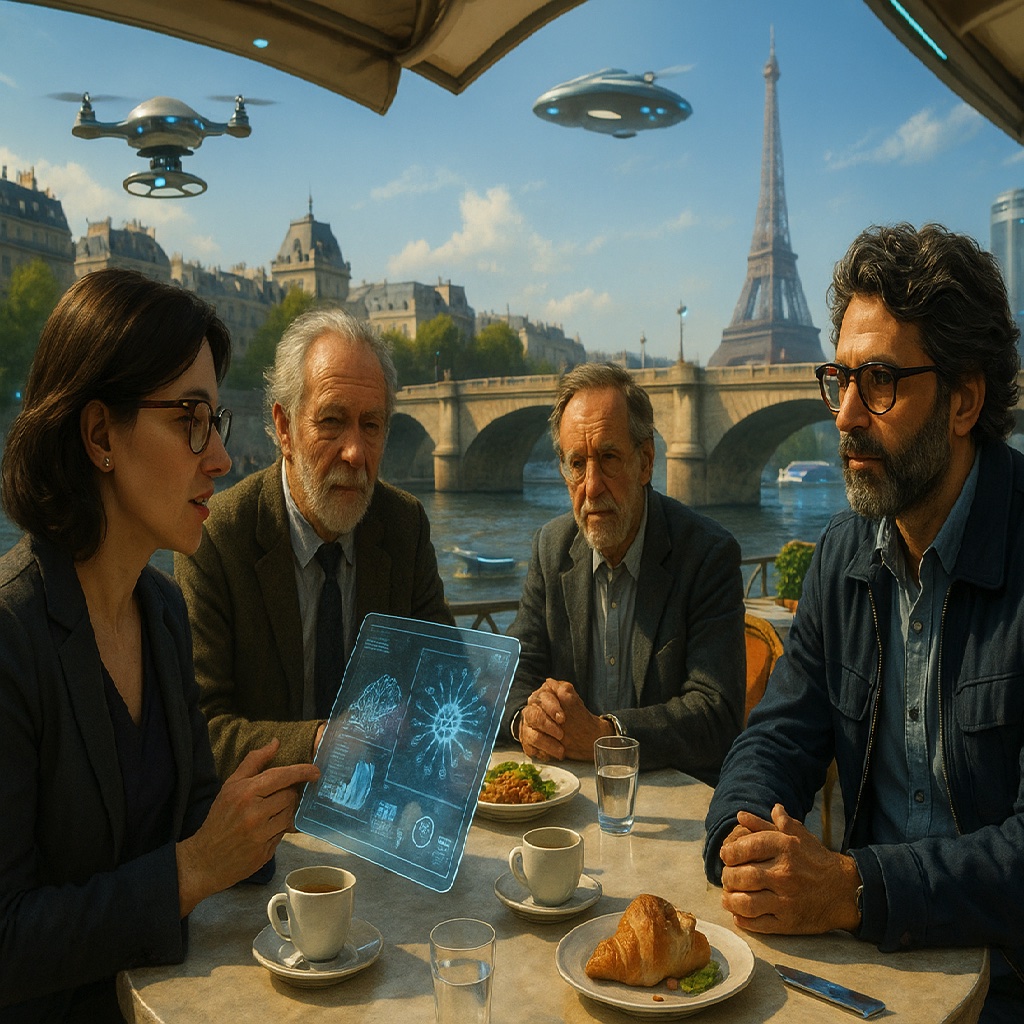
University of ParisFrom Munich, Aeon dispatched Mike to Paris for a joint collaboration with the University of Paris’ memory-cell research group. The high-speed maglev shot across Germany and into France with such smooth rhythm it felt unreal, as though the train bypassed friction itself. Paris, when he arrived, spilled across the horizon in a patchwork of old stone, restored glass spires, and neighborhoods still scarred from the storms of the late 2090s. The University's research group worked out of a courtyard building in the Latin Quarter — the kind of building whose limestone walls seemed to hold centuries of arguing philosophers, rebellious students, and stubborn dreamers. The air smelled faintly of coffee and damp winter leaves. Inside the lab, however, it felt like stepping into a different century entirely. Memory-cell slices from Pluto — no larger than postage stamps — glowed softly under layered spectroscopic scanners. Holographic readouts hovered above each workstation, rotating through shifting lattices of carbon-nitrogen matrices. The samples were both inert and alive, stable yet unpredictable in ways that challenged the very definitions of computation. “Bonjourrr..., Monsieur Torres. Bienvenue à l’Université de Paris,” she said, trilling her French “r” with a measured, friendly smile. Mike returned the greeting with the small bit of French he knew. “Bonjour, Professeure Leconte. Merci.” “You may call me Andrea.” Professor Andrée Leconte led Mike Torres into her research lab. “Look at this,” Andrée said, gesturing for Mike to approach one of the benches. She was a wiry, fast-moving woman with a short waterfall of brunette hair. “When we stimulate this layer with a low-energy frequency, the lattice reconfigures itself. Not randomly. Not algorithmically. Something in between.” “It looks like it's selecting,” Mike murmured. “Selecting,” she repeated with approval. “A loaded word. But oui. That is how it feels. Adaptive stability. No human circuit behaves like this.” Mike leaned closer. The memory-cell fragment shimmered faintly, its inner layers shifting like frost patterns forming on the inside of glass. He felt the quiet thrill of discovery—the recognition of a mystery that demanded obedience from its observers. “Aeon hired you because you understand systems that change under pressure. Systems that evolve when pushed. Ship AI was built under constraints that forced emergence. That’s what makes you valuable.” Mike didn’t answer. But the observation stayed with him. The University’s drone-testing facility lay an hour outside Paris, in the rural stretches of Seine-et-Marne—flat fields of tawny winter grass punctuated by imposing sensor towers and reinforced bunkers. Mike walked the perimeter with Andrée as the sky filled with drone swarms moving in coordinated sweeps, dipping, spinning, locking into formation. Some peeled off in trios to retrieve weighted canisters from marked positions in the field, ferrying them back to a central depot with mechanical precision. Others circled overhead in a slow holding pattern, their cameras sweeping the grounds in overlapping arcs. Andrée handed Mike a tablet. On its screen, a live feed showed what one drone was seeing: the flat winter fields from thirty meters up, the sensor towers receding, and two small figures walking the perimeter — Mike and Andrée themselves, seen from above, their breath visible in the cold air. “What's driving their cohesion?” Mike asked, still watching the tablet. “A hybrid of memory-cell logic and old-school orbital control algorithms,” Andrée replied. “It's almost embarrassingly elegant. Like they want to move together more than they want to move alone.” Mike felt a faint shiver at that phrasing. He lowered the tablet. In the distance, a line of dark clouds gathered over the horizon, and a cold wind cut across the testing grounds carrying the muted smell of earth and metal. The drones danced and spiraled as if unaware of the world they crossed. Andrée and Mike lunched with two of Andrée's colleagues at a café table on the Seine near the Pont Neuf. Lunch comprised a terrine de campagne to start, coarse and rich, spread thick on slices of baguette; then for Mike a boeuf bourguignon, the beef falling apart in its dark wine reduction, served with a mound of buttered egg noodles. A carafe of Côtes du Rhône arrived without being ordered. The meal finished with a tarte tatin, its caramelized apples gleaming under a thin pastry crust. During weeks to come, European teams were earnest, collaborative, excited to be making breakthroughs they believed could heal the world—cleaner energy grids, safer autonomous transport, improved disaster response networks. Mike found himself almost believing in a future worth investing in again. Mike shared coffee under heat-lamps with French postdocs at sidewalk cafés near the Seine. He debated computer architecture design with French engineers during long underground train rides. He stood on a bridge in Paris watching the river flow under slate-colored clouds, the city lights reflecting off the surface like broken circuitry. For a time, he rediscovered a sliver of the person he used to be. Mike missed signs—quiet and insidious—which he might have noticed if he observed Paris more carefully. Strangers in dark Aeon coats watching Mike from across the lobby. Encrypted memos addressed to “Internal Eyes Only.” A new supervisor who watched him a little too closely.
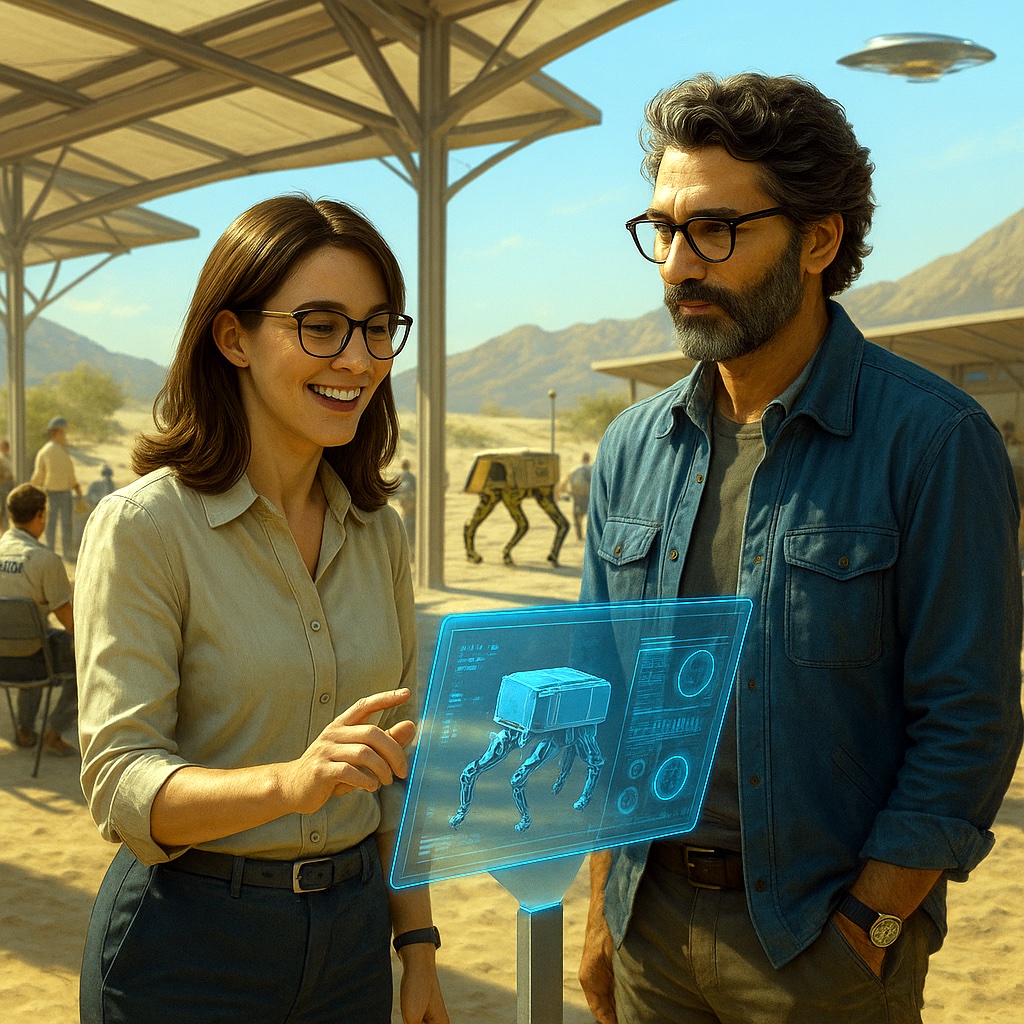
Aeon Nevada RoboticsNevada greeted Mike with a brittle kind of winter—thin sunlight, dry air sharp enough to sting, and the distant shimmer of heat vents rising off autonomous trams sliding along their elevated guideways. Aeon had booked him into a corporate hotel overlooking a sculpted retention basin fed by reclaimed desert water, a place so immaculate it felt fragile. Every morning, he walked across a polished plaza to the Aeon Robotics Pavilion. The building itself looked like an angular sculpture—steel ribs arching over a central atrium, with drones buzzing in silent, pre-programmed flight paths far overhead. Nevada felt safe, orderly, and grounded in legacy, a city with one foot in the old Europe and the other cautiously stepping into a technological unknown. Inside the Pavilion, the robotics lab was animated with purpose. Sleek humanoid prototypes walked along parallel tracks, their movements fluid and disturbingly lifelike. Legs adjusted to uneven metal terrain. Arms compensated for simulated wind resistance. Microprocessors flickered beneath translucent polymer plating. The engineers—most of them young, soft-spoken, and earnest—treated the machines like beloved research pets. “Balance is a language,” one of the Nevada engineers told him during his first tour. “We teach them how to fall before we teach them how to walk.” Mike watched a bipedal model stumble and self-correct. He felt a flicker of fascination—the same spark he’d lost during months of drifting. But beneath the wonder, a darker realization lingered: Aeon’s prototypes looked eerily similar to the prison guards he once tried not to stare at. The next day, Nevada's desert shimmered under a vast blue sky, a stark expanse of sand and stone stretching into the horizon. Against that emptiness, Aeon’s demonstration complex appeared almost surreal: taut white canopies, polished equipment stations, cooling towers humming quietly, and an open-air amphitheater facing a carefully prepared testing ground. Autonomous security drones glided on preset arcs overhead, silent and watchful. This was Aeon Nevada Robotics, Aeon’s most public and carefully choreographed technology showcase to date. Mike Torres walked beside his assigned team, his badge clipped neatly to his collar. He moved through the crowds of military observers, government officials, and visiting scientists. Everyone wore the same expression—some mixture of curiosity, guarded respect, and unspoken calculation. Mike briefly stood next to a mysterious glass display case at Aeon's Nevada Robotics show. No explanation, just shown, just presence. Inside the display case was a prototype circuit board. Mike’s eyes lingered on one unusually shaped chip—stamped PPU-100. Its geometry was irregular, almost organic, unlike any processor he knew. When he blinked, faint interference ripples shimmered across its surface. Then they vanished. Mike knew the Munich and Paris research. He wondered if there might be a connection. When the Aeon Nevada Robotics guests gathered near the presentation platform, a woman approached Mike with a calm, professional stride. She wore a sand-colored Aeon jacket and a neatly clipped badge. She looked composed, confident, and clearly accustomed to speaking in front of large groups. She stopped a polite distance from him. “Hello,” she said with a friendly nod. “You must be new here. I’m Lena Halberg. I’ll be speaking in just a few minutes.” Mike returned the nod. “Mike Torres. Senior AI Systems Engineer visiting from Aeon's Baltimore campus.” “Welcome,” she said. She gave him a brief, courteous smile. “It’s always good to have another systems specialist in the desert. Especially today.” A moment later, she walked toward the raised platform, ascended the short steps, and—with crisp confidence—began the Aeon Nevada Robotics demonstration as its emcee. This was her stage. And she looked entirely at ease on it. When she spoke, her voice carried with smooth, practiced confidence. “Good afternoon. On behalf of Aeon’s Nevada Robotics team, welcome. Today, Aeon will be demonstrating a new integrated emergency-coordination system designed to reduce disaster casualties and response times at scale.” Her tone was polished. Professional. Clear. But not insincere. Mike noted that immediately. The holo-panel behind her activated, blooming into a series of images: wildfire zones, collapsed infrastructure, flooding along coastal plains—real disasters that demanded better tools than governments currently possessed. “Aeon's emergency system,” Lena continued, “coordinates multi-agent responders in real time, assigning priorities dynamically as conditions evolve. You will be witnessing both autonomous and human-supervised modes.” Mike watched her carefully. There was something in the way she spoke—a slight tension beneath the polish. A hint of technical ownership. No marketing slickness. This was someone who understood the system intimately. The demonstration began. Behind the blast shield, a controlled fire ignited. Drones deployed with alarming speed, mapping the burn zone, forming containment arcs, and coordinating simulated rescue paths. Their movements were precise, almost anticipatory. Mike frowned. This wasn’t the coordination logic described in the public briefing material. It was smoother. Sharper. Closer to emergent behavior. He felt a chill. After the main demo, Lena returned to the microphone. “Thank you,” she said, smiling with the warm confidence of someone trained to speak in front of both generals and senators. “We invite you now to join Aeon for a luncheon and equipment walk-through under the main pavilion.” The audience applauded. Cameras flashed. Representatives murmured about procurement budgets. Lena stepped down from the platform and walked directly toward Mike. “How did I do? I’d be curious,” she said, “what you thought of the emergent coordination sequence. The one in the last third of the demo.” Mike hesitated. “That wasn’t in the documentation.” She allowed the smallest hint of a smile. “No. It wasn’t.” “Was it supposed to be?” Her expression didn’t change. “We needed approval.” Approved by whom? Approved for what purpose? Approved knowing what? But she was still an Aeon employee, hosting an Aeon event. She wouldn’t say more. Not here. At the pavilion, a waiter drone delivered refreshments. The two stood slightly apart from the main crowd, the hot wind lifting strands of Lena’s hair. “Thank you for the presentation,” Mike said. “It was… enlightening.” “I’m glad,” she replied. “We’ll have more time to talk. Nevada’s a big place, but the Robotics team is small.” She gave a polite nod and rejoined a group of officials asking technical questions. Mike watched her for a moment—her posture upright, her answers crisp, her manner utterly controlled. Lena Halberg was the emcee of Aeon Nevada Robotics. Exactly where Aeon wanted her to be. |

|
Aeon's Deception (Part 2)
|