|
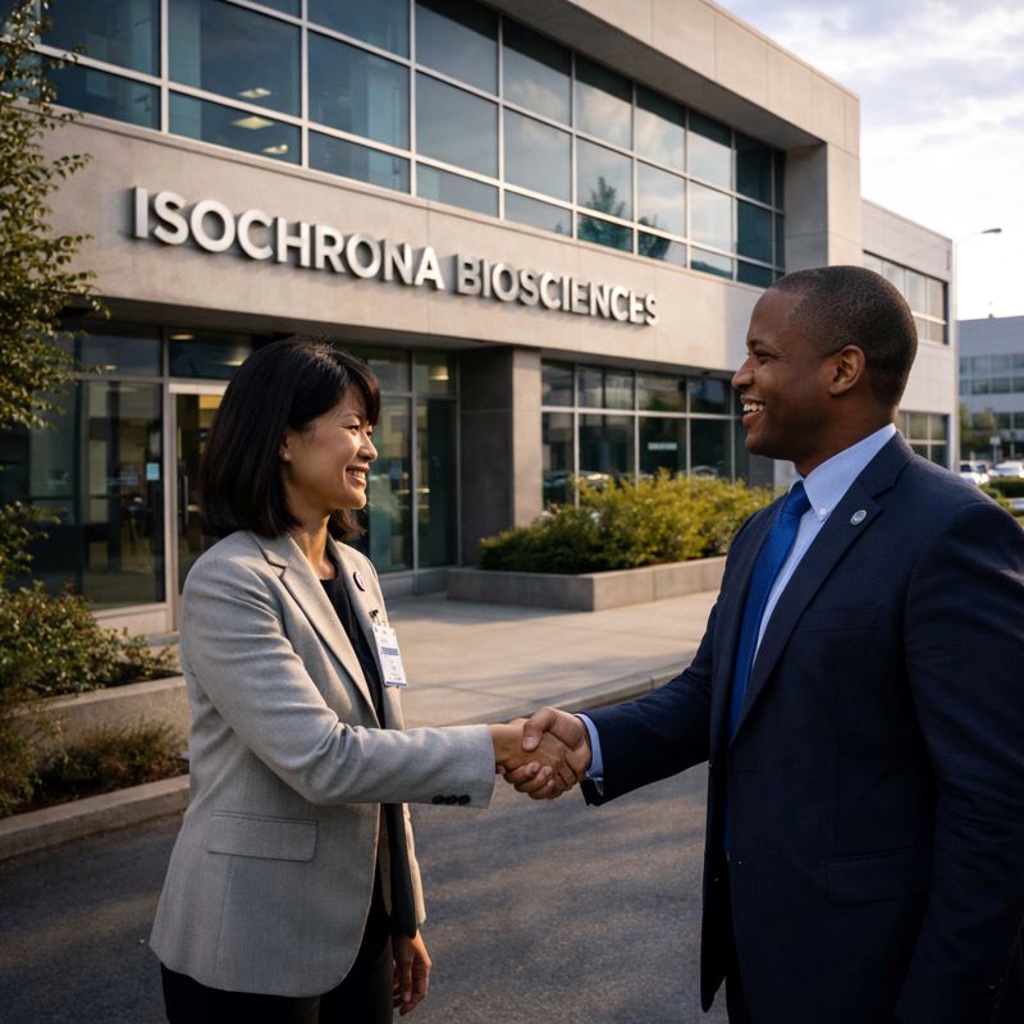
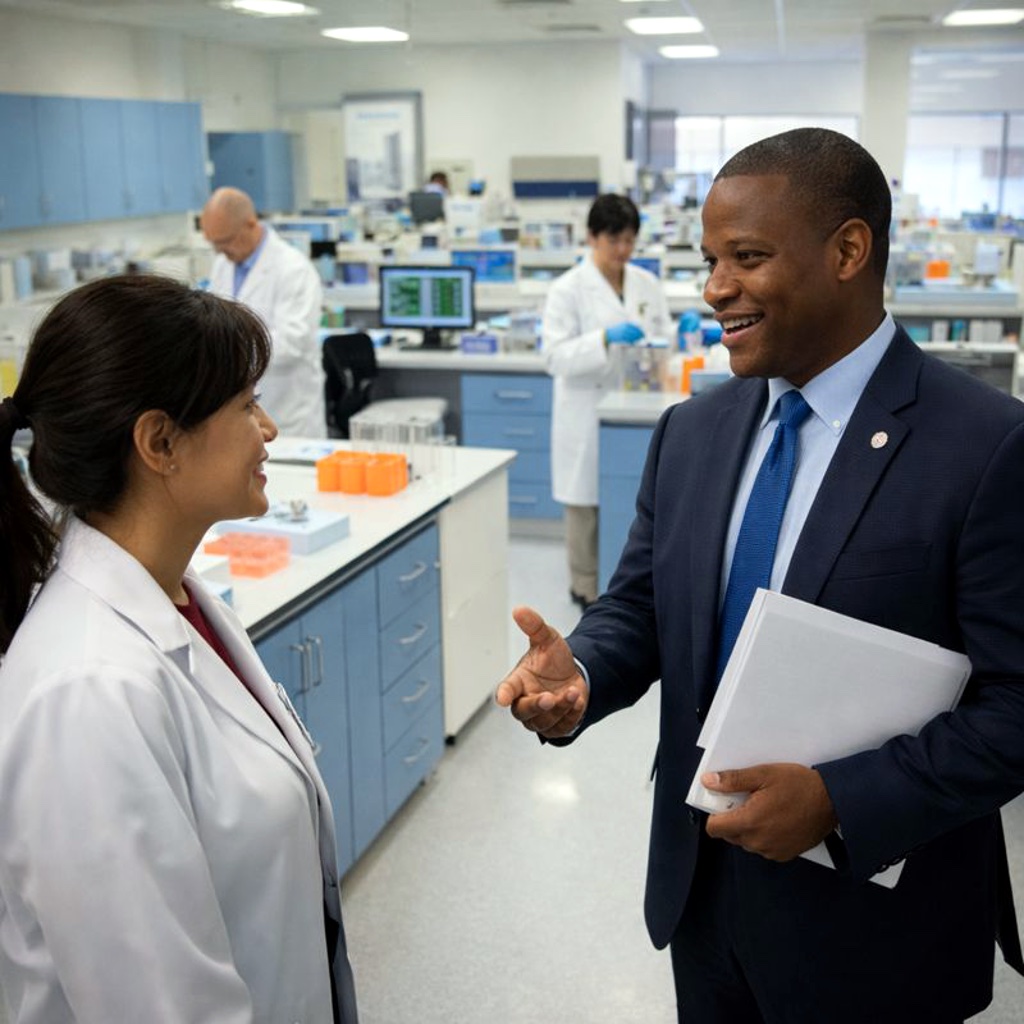
New HireDr. Samuel Kerr arrived early, more out of habit than necessity. The badge he’d been issued the week before worked on the first try. The doors opened silently, and the lobby revealed itself without ceremony: glass, concrete, light. No banners. No slogans. No timeline of achievements on the wall. Just a small, brushed-metal sign with the company name and a reception desk that looked as if it had been designed to disappear when not in use. Margaret Liu was already waiting. “You found us,” she said, smiling as she shook his hand. “Good. That’s usually the first test.” He smiled back. “I was expecting more security.” “You’ll see it,” she said. “You just won’t notice it.” They began walking before he could ask what she meant. The building unfolded in sections, not floors. Each lab opened onto the next with glass partitions that offered visibility without intimacy. People worked quietly, efficiently, moving between stations with the unhurried confidence of teams that had already solved their hardest problems and were now living with the solutions. “We’re about five hundred people,” Liu said as they passed a cluster of offices. “Privately held. Venture funded, but not… aggressively.” She made a small gesture with her hand, as if dismissing something. “We license outward. We swap equity. Everyone’s hedged.” “In case you fail,” Kerr said. “In case anyone fails,” she corrected. “If one of us succeeds, everyone survives. If one of us succeeds spectacularly, history gets rewritten.” She said it lightly. Kerr noted that she did not say if we succeed. They stopped at a lab where a technician was reviewing data on a large display. The screen showed gait analysis—before and after—of a medium-sized dog trotting across a pressure-sensitive surface. The difference was unmistakable. “That’s public,” Liu said, anticipating the question. “Dogs. Cats. Pigs. Primates. We don’t hide animal results. We just don’t editorialize them.” Kerr watched the data scroll. “The dogs—how old were they?” “Equivalent to late sixties, early seventies,” she said. “Arthritis. Cardiac decline. Renal stress.” “And now?” “Now they chase tennis balls again.” She didn’t sound triumphant. She sounded factual. They moved on. In another lab, he saw what looked like a small forest of bioreactors, each labeled with alphanumeric codes rather than names. In a third, immune cells moved across a simulation, responding to markers that shifted in real time. In a fourth, a wall-length display mapped a human chromosome in layered color. “Chromosome 1,” Liu said. “We use it as a maintenance spine.” “You’re rewriting it?” Kerr asked, keeping his voice even. “Maintaining it,” she said. “There’s a difference.” She explained as they walked. The therapy didn’t overwrite the genome wholesale. It installed repair libraries—conditional, staged, responsive. The system identified disadvantageous mutations and age-related drift, then corrected known error patterns using a constellation of CRISPR-like subsystems. Nothing fired at once. Nothing replicated unchecked. “It behaves more like software than surgery,” she said. “Updates roll out. Subsystems report back. If something misbehaves, it’s isolated.” “Like antivirus,” Kerr said. She smiled. “Exactly like antivirus.” They stopped again, this time outside a room with reinforced glass. Inside, primates moved through an enriched environment—climbing, interacting, alert in a way Kerr found difficult to ignore. “Cognition?” he asked. “Improved,” Liu said. “Not enhanced. Restored. Reaction times, memory tasks, social engagement.” “And cancer risk?” “We stepped back from full pluripotency early,” she said. “Partial reprogramming only. OSK-derived pathways without the fourth factor. We learned that lesson from the literature.” He nodded. He had taught that lesson. By the time they reached the cafeteria, Kerr realized he hadn’t felt the usual tightening in his chest that came with large organizations. No branding posters. No mission statements. Just people eating lunch. They took trays and sat. At the next table, two engineers were arguing about parking. At another, someone complained about the espresso machine. A group of researchers laughed too loudly at something that clearly wasn’t that funny. “This is… normal,” Kerr said. “It has to be,” Liu said. “We’re not curing a disease. We’re changing a baseline. If we let ourselves feel that every minute, no one could work.” He looked around. “The public knows about the animals.” “They know,” she said. “They don’t believe. Not really. They’re waiting for humans.” “And the human trials?” She met his eyes. “You’ll see the data soon enough.” After lunch, they visited a smaller lab. Less glass. More whiteboards. Names and arrows and half-erased equations layered over one another. “This is where we lose sleep,” Liu said. “Setbacks. Near misses. Unexpected feedback loops.” She pointed to a cluster of notes circled in red. “Senescent cell targeting went wrong here,” she said. “Too aggressive. Collateral damage. We rolled it back.” “And here?” “Too cautious. No effect. We learned.” Kerr felt something shift—not excitement, but alignment. This wasn’t recklessness. It was iteration. By late afternoon, his badge felt less foreign. His office was small, clean, unfinished. A box of books waited by the wall. Liu stood at the door. “You’ll be busy,” she said. “And you’ll be uncomfortable.” “I already am,” Kerr said. She smiled again, this time with something like relief. “Good. Welcome to Isochrona.” After she left, Kerr stood alone for a moment. Outside his window, the city continued its ordinary motion. Cars moved. People walked. Somewhere, someone worried about rent. He sat at his desk and opened the first file waiting on his screen. The numbers were better than he’d expected. He closed the file without finishing it. Tomorrow, he thought. Tomorrow would be soon enough.
ResearchThe meeting room had no windows and no name. On the internal map it appeared only as a rotating code, updated every few weeks. The walls were layered whiteboards over older whiteboards, corners crowded with half-erased equations, pathway diagrams, timelines, and annotations that no longer made sense without their authors present. Dr. Samuel Kerr arrived early and took a seat against the wall. He had learned quickly that this was the best place to listen. Dr. Elena Márquez stood at the front, scrolling through slides that were not meant for presentation. They were working documents: dense, provisional, argumentative. Dr. Rajesh Patel sat nearby with a tablet balanced on his knee, occasionally tapping notes into it. Dr. Aisha Reynolds leaned against the table, arms crossed, watching the room rather than the screen. The meeting room lights dimmed. Márquez presented slides. “This is how Pill 35 is administered. Our regimen isn’t just a pill,” Márquez said. “Not at first.” Her screen shifted to three vertical bands labeled simply: Phase I, Phase II, Phase III. “Phase One is installation,” Márquez said. “Chromosome 1 architecture delivered intravenously, under controlled clinical conditions. Hospital-grade monitoring. For now, physician-only administration.” “Phase Two is the visible part. One Pill 35 per day. Approximately twelve months. That’s where telomere restoration, mitochondrial normalization, endocrine recalibration, and epigenetic convergence occur.” “Phase Three is maintenance. One pill every ten days. Optional discontinuation. If the subject stops, biological aging resumes.” “Pill 35 isn’t obligation-free,” she said. “Early subscribers must supply Isochrona Biosciences with data to keep Isochrona Biosciences research advancing further ahead.” “Got it.” Kerr nodded. “What happens if an unauthorized person takes Pill 35?” “Not much, if done in small quantity. Pill 35 is inert without a monitored Phase 1 installation. In large quantities, your stomach might get pumped in ER, as if you had a vitamin overdose.” “How much progress have we made?” Márquez passed the torch. “Rajesh?” Dr. Rajesh Patel took over the slide show. “Lot 40G is stable,” Patel said at last. “That’s the good news. The bad news is that lot 40F was stable too. Until it wasn’t.” Patel advanced the slide. A lattice of charts appeared, color-coded by subsystem: telomere dynamics, mitochondrial restoration, endocrine modulation, senescence clearance, and epigenetic reprogramming. “We’re still seeing drift in late-stage cellular identity,” she said. “Not enough to trigger uncontrolled proliferation, but enough to make me uncomfortable.” “Cancer?” Kerr asked. “Not directly,” Patel said. “Closer to boundary instability. The cells remember how to become younger. We have to keep them from remembering how to become anything else.” Dr. Aisha Reynolds stepped forward. “We had a near-miss in the senescence sweep last quarter,” she said. “Over-targeting. We cleared cells we thought were senescent but weren’t. Functional loss, localized.” “How bad?” Kerr asked. “Bad enough to roll back,” Reynolds said. “Not bad enough to lose the subject.” No one reacted. This was the language of people who had already internalized risk. Patel brought up a new display. Chromosome 1 filled the screen, rendered in layered bands of color, annotated with markers for regulatory regions, telomere-adjacent domains, and repair loci. “This is where the architecture matters,” he said. “We’re not rewriting the genome. We’re installing a control layer.” He zoomed in further. “Think of it as a maintenance spine,” he continued. “Repair libraries live here. Update logic lives here. The system doesn’t act unless called, and it only calls what is appropriate for that tissue, at that time.” “Like staged updates,” Kerr said. Patel nodded. “Exactly. Nothing global. Nothing simultaneous. Everything staggered. We learned from early models that synchronized activation creates systemic shock.” Márquez added, “Immune backlash. Inflammatory cascades. Endocrine destabilization. The biology revolted.” Reynolds exhaled slowly. “That was a bad week.” They moved on. A new slide appeared, showing longitudinal human trial data. The graphs were dense with markers: telomerase reverse transcriptase (TERT) activity, NAD+ levels, mitochondrial efficiency, insulin-like growth factor 1 (IGF-1) trajectories, and epigenetic age curves. Kerr leaned forward. “These convergence patterns,” he said. “How confident are we that they aren’t masking something?” Patel answered without hesitation. “We’re confident they’re real. Baseline variance collapses because the system is correcting toward a reference state.” “Age thirty-five,” Kerr said. “Yes,” Márquez said. “Approximately. It isn’t magic. It’s where the data clusters when telomere length, mitochondrial function, endocrine balance, and epigenetic markers converge.” “And the one-year curve?” Kerr asked. Patel opened a restricted slide bordered in red. “Early deployments without temporal modulation caused systemic overload,” he said. “Rapid telomere extension, accelerated mitochondrial restoration, endocrine overshoot. It worked—but too fast.” “So you slowed it down?” Kerr said. “No. That was Chronexia,” Patel said. “Chronexia's Temporal Homeostasis Architecture (THA) solved this issue.” “Chronexia let the biology breathe,” Márquez said. “Rejuvenation isn’t a switch. It’s a conversation between pathways.” For a moment the room was silent. Reynolds broke it. “Helionyx sent new mitochondrial data this morning.” Patel raised an eyebrow. “Already?” “Primate trial,” Reynolds said. “Post-restoration energy efficiency improved. Not enhanced—normalized. COX7RP-associated supercomplex stability returned to youthful baselines.” Kerr watched their faces. There was no cheering. No celebration. Just recalibration. “And Baseline?” Kerr asked. Patel hesitated. “Their population models are… unsettling.” “How so?” “They can predict where aging diverges first,” Patel said. “By region. By socioeconomic markers. By exposure history. By chronic inflammation signatures.” Márquez added quietly, “Which means we can correct it. Or choose not to.” That landed. Kerr leaned back. “You realize this isn’t just a medical intervention,” he said. “It’s a demographic intervention.” Reynolds nodded. “We know.” “And you’re still moving forward.” “Yes,” Márquez said. “Because we already have.” The meeting dissolved into smaller conversations. Kerr drifted to the edge of the room, listening. One group debated apoptosis thresholds for senescent-cell clearance. Another argued about immune retraining windows and aptamer-based targeting. A third discussed licensing calls scheduled for later in the week—quiet exchanges of data, equity, and leverage. Isochrona was not alone. It was entangled. Later that afternoon, Kerr sat with Márquez in her office. A single plant occupied the corner. It looked healthy. “You’re worried about something you’re not saying,” he said. She didn’t deny it. “We’re fixing aging,” she said. “But we’re not fixing history. People arrive at thirty-five with very different bodies.” “You mean injuries,” Kerr said. “Surgeries and loss.” She nodded. “The system can repair telomeres, restore mitochondrial function, stabilize endocrine pathways, and reprogram epigenetic drift. It cannot regenerate irreparable loss nor what never existed.” “That creates a new kind of inequality,” Kerr said. “Yes,” she said. “But so does aging.” By evening, Kerr returned to his office. The sun was low, casting long shadows across the floor. He opened a file he had avoided earlier: longitudinal projections. The models were explicit. Pill 35 was not a single compound. It was an orchestrated stack: programmable DNA packages installed across Chromosome 1, CRISPR-like subsystems deployed in layers, telomere repair protocols, mitochondrial restoration routines, and staged senescence clearance. Each update propagated through the bloodstream as a coordinated signal network, adjusting itself like a biological operating system receiving incremental upgrades. Kerr read quietly. The numbers were consistent. Reproducible. Unforgiving. This worked. Whatever came next would not be a question of possibility. It would be a question of choice. He closed the file and sat for a long time without moving. Outside, South San Francisco continued to age at its usual pace. Inside Isochrona Biosciences, that pace had already begun to change.
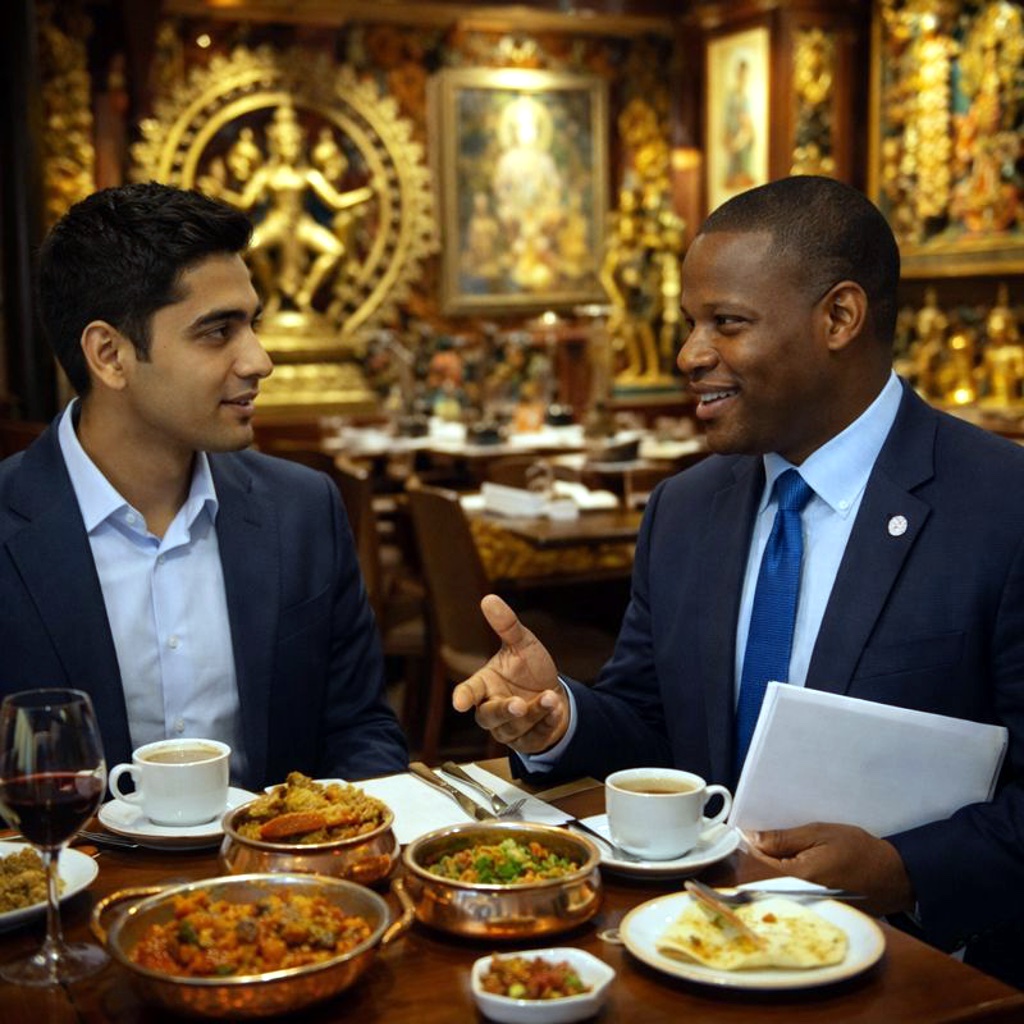
DNA Computing“Let me pick the restaurant,” Rajesh Patel said. “Where?” Kerr asked. “Rooh,” Rajesh said. Kerr looked at him. “What is Rooh?” Rajesh considered the question briefly. “It means ‘soul,’” he said. They left Isochrona’s parking lot. Not long afterward, they were seated inside Rooh, a Northern Indian restaurant tucked along a quiet San Francisco street. Inside, the air was warm with cumin, coriander, cardamom, and slow-cooked onions. Rajesh ordered without hesitation: lamb rogan josh, saag, dal makhani, tandoori chicken, garlic naan, and mango achar. He added two cups of masala chai, sweetened with sugar. “You grew up with this?” Kerr asked. Rajesh nodded. “Bangalore. My father taught at IIT. Electrical engineering. Systems theory.” “That explains it. People raised around systems tend to see biology as architecture,” Kerr said. Rajesh considered this. “And you?” “I was at CDC in Atlanta, Georgia,” he said. “Director of a microbiology unit. Pathogen dynamics, long-horizon biological risks.” “And then?” Rajesh asked. “My division was dissolved,” Kerr said. “Budget realignment. Strategic priorities. My team disappeared. Including me.” Rajesh nodded once. “So I went west,” Kerr said. “Isochrona is my new home. Not reacting to collapse. Designing stability.” The food arrived. Steam rose from copper bowls. Rajesh poured chai into porcelain cups, the sugar dissolving slowly. “I hear you’ve published a lot,” Kerr said. “Nature Biotechnology. Cell. Science Translational Medicine. Some papers alone. Some coauthored with other Isochrona employees.” Rajesh did not respond immediately. “People inside Isochrona talk about you as if you’re the lead scientist,” Kerr continued. “Even if your title doesn’t say so.” Rajesh shrugged slightly. “I collaborate with many people,” he said. “Isochrona is not built around individuals.” “Here's what I want to know,” Kerr said. “How does Pill 35 actually work?” “Most people think Pill 35 is a drug,” Rajesh said. “It is not. Phase One is gene delivery.” “Viral vectors,” Kerr said. “Yes,” Rajesh said. “But not only viral vectors. Adeno-associated viruses, lentiviral systems, lipid nanoparticles, polymeric carriers, engineered exosomes. Each targets different stem-cell populations—hematopoietic, mesenchymal, neural progenitors.” “You’re distributing the system,” Kerr said. “Yes,” Rajesh said. “We cannot install a global architecture in a single event. The genome rejects monolithic intervention. So we fragment the payload.” He tore naan slowly. “The Chromosome 1 package is modular,” Rajesh said. “Regulatory sequences, synthetic promoters, conditional enhancers, programmable recombinases, kill-switches, feedback circuits. Each module installs separately, then synchronizes.” “So Phase One is not editing,” Kerr said. “No,” Rajesh said. “Phase One is scaffolding.” He tasted the lamb before continuing. “Phase Two uses CRISPR systems,” Rajesh said. “Cas9 for double-strand breaks, Cas12 for multiplex targeting, Cas13 for RNA-level modulation. Base editors correct point mutations without cleavage. Prime editors perform templated rewrites.” “And epigenetics?” Kerr asked. “DNA methylation resets. Histone modification control. Chromatin accessibility modulation. We do not merely repair sequence; we reprogram regulatory topology.” “But CRISPR is reactive,” Kerr said. Rajesh looked at him with faint approval. “Exactly,” he said. “Repair is not intelligence.” “So we explored computational frameworks,” Rajesh said. “Membrane computing,” he said. “P systems. Biological compartments as computational units. Elegant, but too discrete. Cells are not isolated processors; they are entangled systems.” He sipped chai. “Then wetware computing,” he said. “Neural substrates as computational media. Powerful, emergent, unstable. Wetware optimizes cognition, not cellular governance.” Kerr did not interrupt. “So we turned to DNA computing,” Rajesh said. “DNA computing uses molecular interactions as logic gates,” Rajesh said. “Hybridization reactions, strand displacement cascades, enzymatic amplification, molecular automata. Computation occurs through biochemical state transitions.” “The real breakthrough came when early researchers built molecular switches (MSs) that behaved like threshold transistors. Decision-tree logic in DNA. Molecular switches were demonstrated during the SARS-CoV-2 era. Viral sequences were inputs. Four fluorophores — FAM, Cy3, ROX, Cy5 — provided multichannel outputs you could see with a UV lamp in minutes.” Rajesh sipped his chai. “Instead of asking 'Which variant is this?', Chromosome 1 asks 'Which physiological trajectory is this cell on?' The MS network evaluates telomere stress, mitochondrial output, proteostasis, inflammation, epigenetic drift — crosses thresholds — and selects repair responses.” “So Chromosome 1 is not just data,” Kerr said. “No,” Rajesh said. “It is a distributed computational substrate.” He leaned slightly forward. “Each treated cell runs local MS decision circuits,” Rajesh said. “Repair pathways are selected through probabilistic evaluation of molecular states. Telomere dynamics, mitochondrial efficiency, proteostasis signals, senescence markers, inflammatory signatures, endocrine feedback loops.” The chai cooled between them. Rajesh took another sip. “But this is more than computation,” Kerr said. “Yes,” he said. “Isochrona did not build a biological computer. That would be insufficient.” “What did you build?” Kerr asked. “A governance layer. We regulate transcription cascades,” Rajesh said. “We initiate and terminate protein expression. We orchestrate growth factors, apoptosis pathways, mitochondrial biogenesis, immune retraining signals.” “Cytokines. microRNAs. Synthetic transcription factors. Programmable ribozymes. Feedback-controlled proteomic pulses.” “So Pill 35 isn’t just a pill?” Kerr said. “No,” Rajesh replied. “Phase I is installation of Isochrona's operating system on Chromosome 1 by IV in a medical setting. Phase II oral dosages are more like compilable application source code packages and antivirus updates. They can’t do anything without Isochrona Phase I. Isochrona's operating system can’t synthesize every chemical ingredient in situ. Our oral regimen is a complement.” “And the objective function? The system must optimize something,” Kerr said. “What does it optimize?” “We define the objective function as long-term physiological stability under constrained metabolic cost. If you let biology compute, you no longer fully control what it decides is optimal.” Kerr and Patel paid for their meals and left Rooh restaurant, leaving tips. Soon they were back on the highway toward South San Francisco. Outside Isochrona Biosciences, the parking lot was unchanged. Inside, Dr. Samuel Kerr and Dr. Rajesh Patel returned to work on human Chromosome 1.
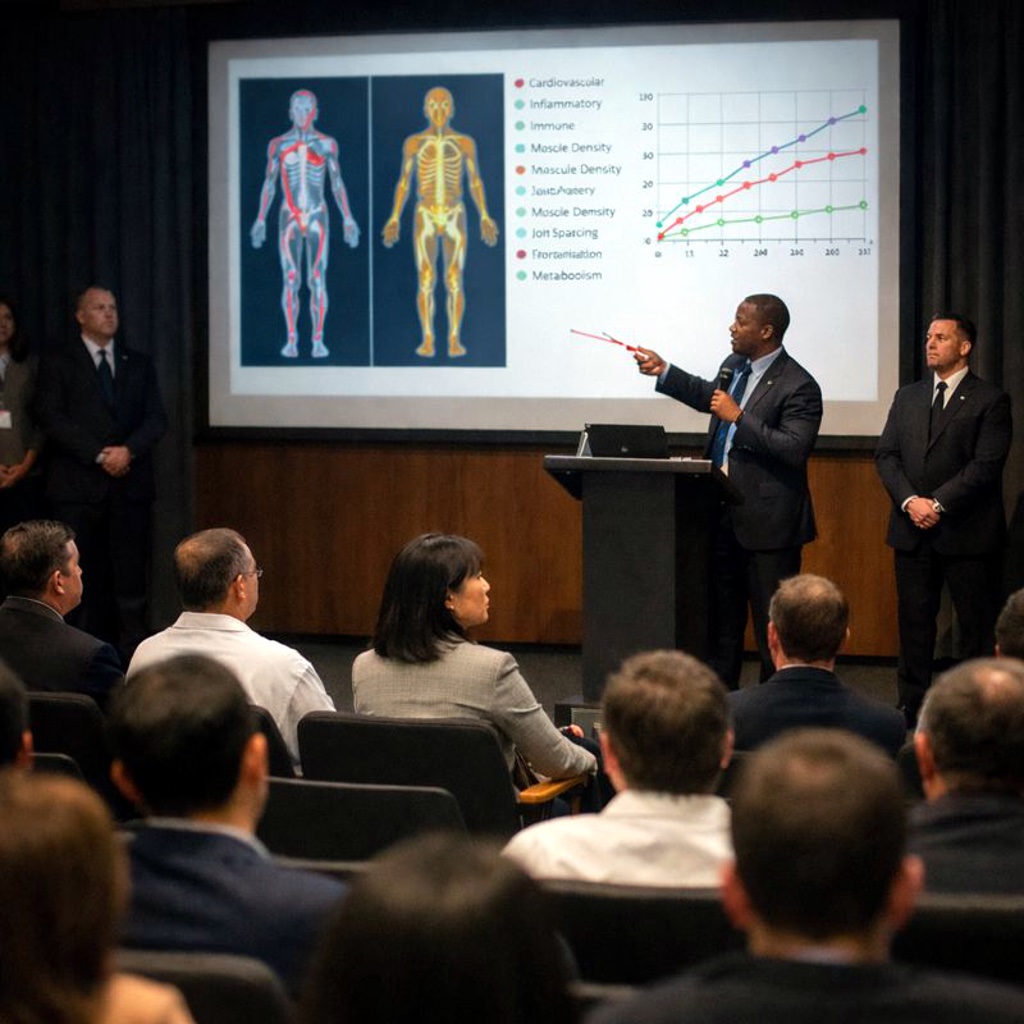
AnnouncementIsochrona's auditoreum was more crowded than usual for an internal briefing. The room was filled to capacity, standing-room only, employees standing in back and lining walls, arranged with the kind of quiet urgency that suggested a late decision made by people who disliked improvisation. Knees brushed when attendees shifted. The air carried a low, contained hum. Phones were face-down. Some had already been sealed into gray pouches stacked neatly near the entrance, each marked with a handwritten number. At the front, a lectern stood before a wide screen. The slide displayed was simple, almost stark: black text on a pale background. Isochrona Biosciences Margaret Liu waited until the room settled into something close to stillness. She didn’t wait for silence. Room lights dimmed. “Thank you all for coming on short notice,” she said. Her voice was calm, practiced, unadorned. “I know some of you rearranged schedules to be here. I’ll be brief.” She glanced down once, then back up. “This is an internal scientific briefing. It is confidential. What you’re about to see is not a product announcement, not a public statement, and not a projection. It is data generated inside Isochrona Biosciences, under approved protocols.” She paused. “We’ll have time later—much later—for implications. Today is about results.” She turned slightly, gesturing toward the first row. “Dr. Samuel Kerr is Director of Human Rejuvenation Research. He’ll present the findings.” Dr. Kerr stood from a seat a few rows back. Several other lead scientists remained seated nearby, hands folded, eyes forward. They did not look at one another. They had the posture of people who had already absorbed the weight of what was about to be said. Dr. Kerr walked to the lectern without hurry. He adjusted the microphone once. “Good afternoon,” he said. “I’ll keep this focused.” The slide advanced. “This Phase I study enrolled sixty-four subjects,” he said. “All participants were over the age of thirty-five. Ages ranged from thirty-six to eighty-one. Administration was oral, daily, over twelve months.” Another slide. “We tested younger cohorts earlier,” he said. “We observed no measurable effect below thirty-five. This intervention does not enhance youth. It appears to act only once age-related decline has begun.” He let that sit before continuing. “The earliest changes were functional,” he said. “Energy levels, sleep quality, recovery time. These were reported within the first three months and corroborated by wearable and clinical data.” The slide changed again. “By months four and five, we began to see systemic shifts. Cardiovascular markers normalized. Chronic inflammation dropped. Immune response profiles aligned with those typically observed in individuals in their mid-thirties.” A subtle movement rippled through the room—people leaning forward, elbows finding knees. Dr. Kerr advanced the slide. “I want to show you imaging.” Two full-body scans appeared side by side. “These are from the same subject,” he said. “Left is baseline. Right is month eleven.” He raised the remote slightly. “What you’re seeing is structural change,” he said. “Muscle density. Joint spacing. Vascular organization. This is not cosmetic smoothing. It’s systemic restoration.” The room was silent now. Next slide. “These plots represent multiple physiological systems,” he said. “What matters is not the individual lines, but their convergence.” He paused. “Subjects did not return to personal baselines,” he said. “They converged toward a common range.” Another click. “Approximately age thirty-five.” No one spoke. Dr. Kerr did not linger on the slide. “We need to be explicit about limitations,” he said. “This intervention does not regenerate absent anatomy. Lost limbs do not return. Surgically removed organs do not regrow. Scar tissue remains scar tissue.” He looked up from the lectern. “This is not regenerative medicine,” he said. “It is restorative. It acts on what is still present.” Another slide. “Neurological outcomes improved where decline was age-related,” he said. “Damage from trauma or stroke did not reverse.” He took a breath. “At twelve months, all subjects who completed the protocol demonstrated physiological profiles consistent with approximately mid-thirties baselines. Variance narrowed. The effect stabilized.” The slide changed one last time. A simple table. Clean. Final. “At this point,” Dr. Kerr said, “we have no evidence that the effect is temporary.” For a moment, nothing happened. From somewhere in the back rows, a woman’s voice, unguarded and audible, spoke. “Oh, my God!” No one corrected her. Applause and cheering started. The room erupted. Margaret Liu rose from her seat, rejoined Dr. Kerr on stage, and reaching out, took Dr. Kerr’s hand in both of hers. She shook it vigorously, then turned, smiling now in a way she hadn’t allowed herself all afternoon. “Thank you, Dr. Kerr,” she said into the microphone, her voice nearly swallowed by the noise. “I hope we see you back here again very soon!” Dr. Kerr leaned toward the microphone, half smiling despite himself. “I’d love to be here again,” he said — his words now almost completely drowned out by the roar of the room. The applause rolled on. People clapped over their heads. Some voiced woops of excitement. Some slapped palms together in sharp high-fives. The sounds filled the auditorium and spilled down the aisles. Margaret Liu leaned towards Dr. Kerr, saying something too quietly to be heard. Dr. Kerr stepped away from the lectern. Two Isochrona Biosciences security officers appeared at the edge of the stage area. They fell into line around Dr. Kerr, one slightly ahead, one slightly behind. As they reached a narrow door set into the side wall, Dr. Kerr turned back toward the room again. He raised his right hand briefly—acknowledging the congratulations one last time. The door closed behind him. The raucous celebration continued. A few people laughed quietly, not from humor but release. Others stayed frozen in their seats. One man stared at his hands, turning them slowly as if checking for a difference that wasn’t there yet. A woman near the aisle opened her calendar on her phone, then stopped, realizing she didn’t know what she was trying to schedule. Nothing else was announced. The screen went dark. |

|
Pill 35 (Part 1)
|